Why Fragrance Smells Different on You
The relationship between skin chemistry and fragrance is real, measurable, and largely misunderstood. Whether you wear perfume or cologne, your skin does not simply carry a scent. It rewrites it.
Skin Chemistry
Microbiome
Men & Women
By Belldiva Editorial • 2026 • 12–14 min read
You smelled a fragrance on someone else and loved it. You bought the same bottle. On you, it smelled like something else entirely. That experience is universal, whether you wear perfume or cologne, and it is not your imagination.
The interaction between skin chemistry and fragrance is genuine biology. Your skin surface carries oil, moisture, acidity, warmth, and an entire microbial community. Each of those variables acts on a fragrance from the moment it lands.
This guide separates what the research genuinely supports from what fragrance marketing repeats without evidence. It covers why the same bottle diverges between two people. It also explains why paper strips mislead, and how to choose scent accordingly. Where the science is strong it is named, and where it is thin that is said plainly.
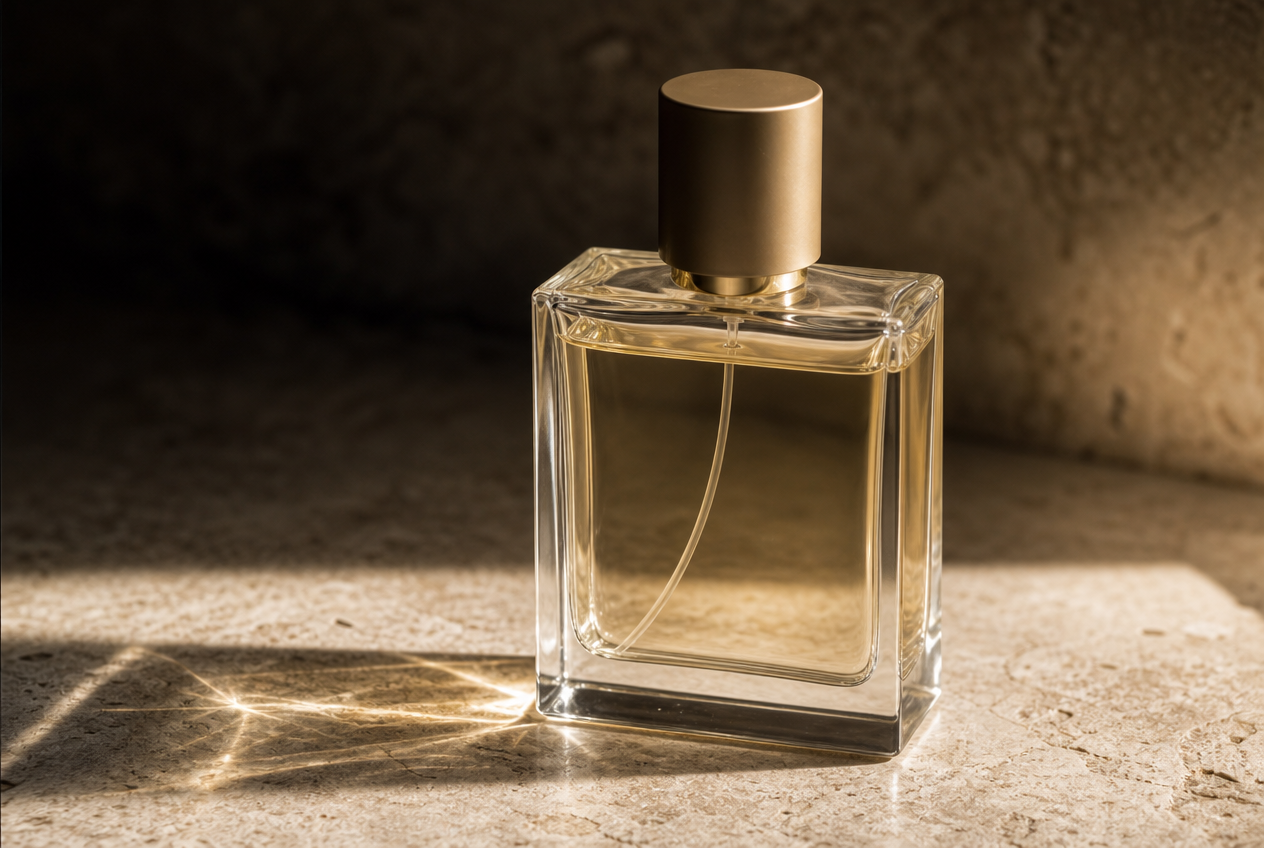
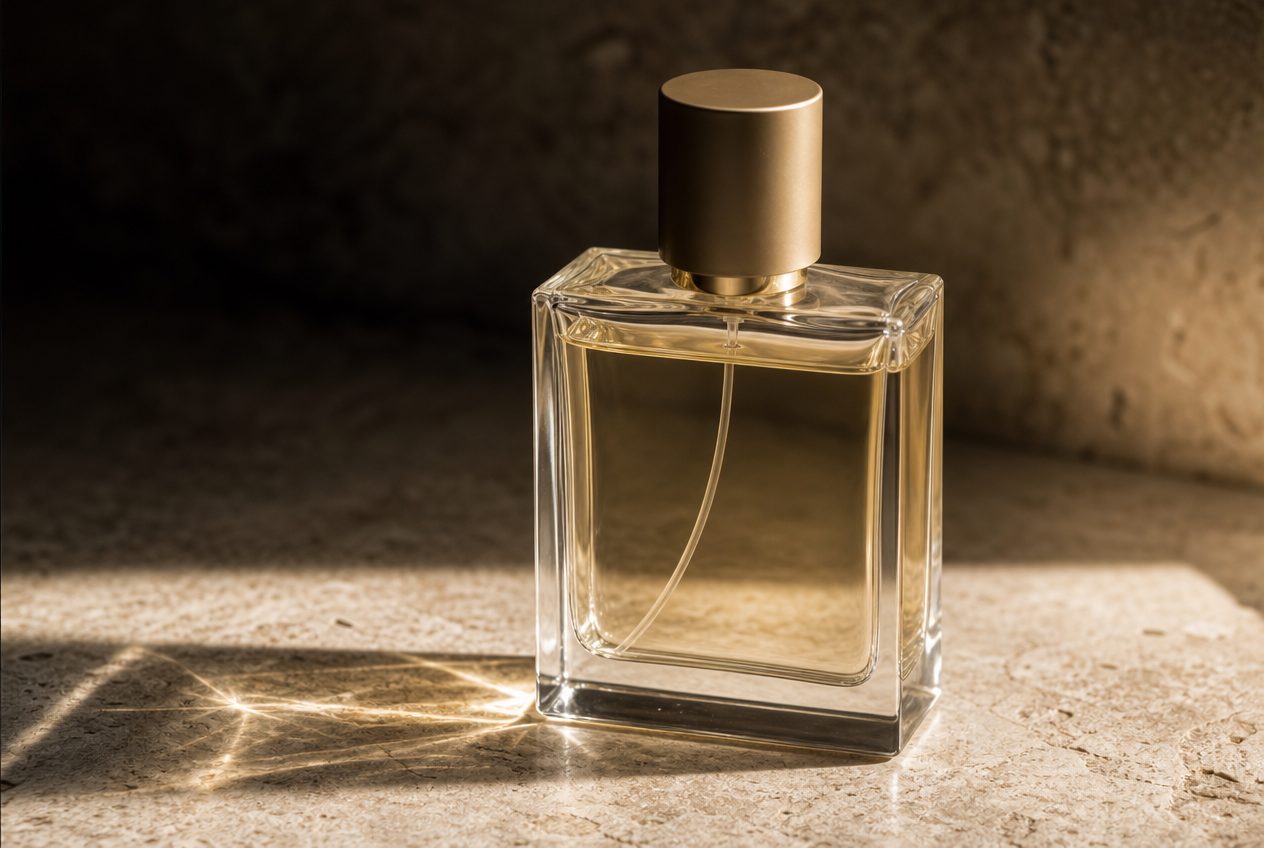
A fragrance is finished on skin, not in the bottle. That is why the same formula diverges between two people.
The Science of Skin Chemistry and Fragrance
Four variables do most of the work. One of them is far more powerful than the fragrance industry usually admits.
Your microbiome is doing the most
Start with the strongest evidence, because it is also the most surprising. Human sweat, on its own, has no smell. Research on skin microbiota established that without bacteria, human sweat is odourless.
Your natural scent is therefore not something you produce directly. Bacteria on your skin convert odourless secretions into volatile compounds that carry smell. A review in Trends in Microbiology describes this as microbial biotransformation, and it is the accepted mechanism.
The species involved are well characterised. Corynebacterium, Staphylococcus, and Micrococcus dominate, with different species favouring different body sites. Consequently, everyone carries a distinct microbial community. That means everyone carries a distinct scent signature underneath any fragrance they wear.
Sebum acts as a fixative
Fragrance molecules are largely oil-soluble, so they bind readily to the oil already on your skin. That binding slows evaporation. As a result, oilier skin tends to hold a scent for longer than drier skin does.
This has a practical consequence worth knowing. Male skin produces roughly double the sebum of female skin. As a result, cologne often lasts longer on a man than an equivalent perfume does on a woman. The Belldiva men’s skincare guide covers that difference in detail.
Hydration, warmth, and acidity
Dry skin loses water outward through the barrier, and that outward flow carries fragrance molecules away faster. A well-hydrated barrier holds scent closer to the surface for longer. This is one reason the same perfume behaves differently in summer and winter.
Warmth accelerates evaporation, which is why pulse points project more strongly and also fade sooner. Skin acidity sits around a pH of 4.5 to 5.5 and influences enzyme activity during the drydown. Of the four factors, acidity is the one most often overstated in fragrance writing.
Odour produced by human sweat without bacteria present, according to skin microbiota research
Typical pH range of healthy skin, which shapes enzyme activity during the drydown
Approximate difference in sebum output between male and female skin, which anchors scent for longer
Without bacteria, human sweat has no smell at all. Your scent is not something you produce. It is something your microbiome makes on your behalf.
Perfume, Cologne, and What the Labels Mean
Before choosing anything, it helps to know that the category names describe strength, not gender.
Concentration, not gender
The words on a fragrance box refer to how much aromatic oil sits in the alcohol base. Parfum carries the most, followed by eau de parfum, then eau de toilette, then eau de cologne. Higher concentration generally means longer wear.
Notice what is absent from that list. None of those terms describes who a fragrance is for. In practice, cologne became shorthand for men’s fragrance in North America. Originally the word simply described a light concentration worn by everyone.
How a fragrance unfolds
Fragrance is built in layers that reveal themselves over hours. Top notes are small, light molecules that lift away quickly. Heart notes follow, and base notes are heavy molecules that linger longest.
This structure matters for a specific reason. The drydown is the stage where base notes dominate. By then your skin has had the most time to act on the formula. Therefore the divergence between two people is widest at the end, not the beginning.
Fragrance Strength, Strongest to Lightest
Longer wearing
Parfum, the most concentrated
Eau de parfum, the common premium format
Lighter wearing
Eau de toilette, fresher and softer
Eau de cologne, the lightest of the four
These terms describe concentration only. Any of them can suit anyone, whatever the marketing on the counter suggests.
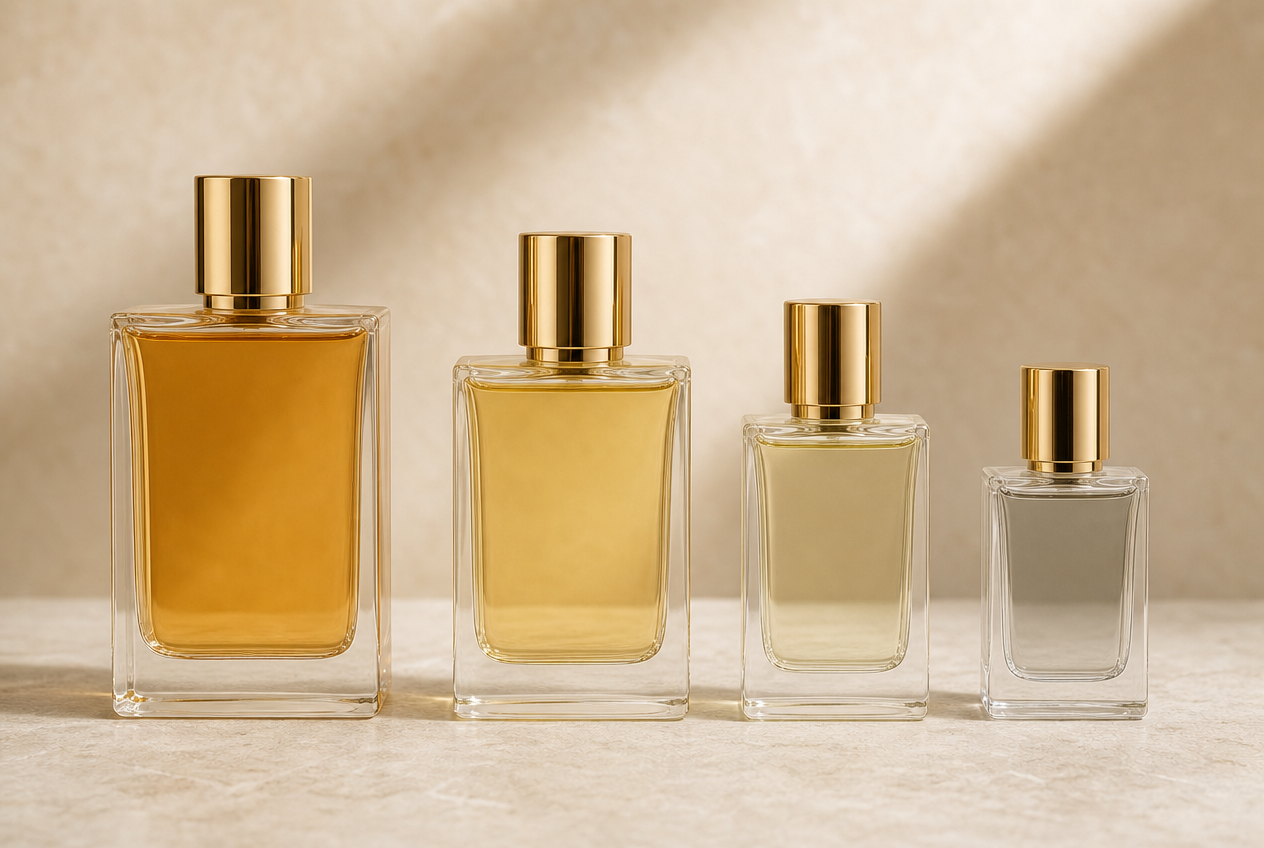
Parfum, eau de parfum, eau de toilette, and cologne describe strength rather than who a scent belongs to.
Where Fragrance Advice Outruns the Evidence
Much of what circulates about making scent last comes from retailers rather than researchers. Here is how to tell the difference.
The claims worth trusting
Some advice rests on straightforward physics and holds up well. Fragrance molecules bind to oil, so moisturised skin genuinely retains scent for longer. Heat speeds evaporation, so warm areas project harder and fade sooner.
Similarly, higher concentrations do last longer, since there is simply more aromatic material present. These are mechanical claims about evaporation, and they are sound.
Skin chemistry and fragrance claims that deserve scepticism
Precise numbers are the warning sign. Some claims name a specific number of hours added by a particular oil. Others name a set volume of water daily. Both appear on retailer blogs with no study behind them.
The advice against rubbing your wrists is similarly repeated everywhere. It is plausible, since friction and heat both accelerate evaporation, yet no controlled trial appears to have measured it. Treat it as reasonable practice rather than established fact.
One more distinction is worth drawing. Detailed guidance about which pH suits florals or citrus is largely inference rather than measurement. The underlying chemistry is real, but the specific pairings are not well evidenced.
Sound Advice vs Repeated Folklore
Well founded
Bacteria create body odour from odourless secretions
Oil and moisture slow evaporation
Higher concentration wears longer
Unverified
Exact hours added by a specific oil
Set water intake improving scent wear
Precise pH and note-family pairings
The mechanism behind skin chemistry and fragrance is genuine. The confident numbers attached to it usually are not.
At Belldiva, we would rather tell you which fragrance advice rests on evidence than repeat a number nobody has measured.
Choosing and Wearing Fragrance Well
Once you accept that your skin co-writes the result, the practical approach changes in a few useful ways.
✦
Never buy from a paper strip
A blotter shows you the formula with none of the biology. Paper has no oil, no warmth, no moisture, and no bacteria. It gives you the perfumer’s intention rather than your outcome, so test on skin and wait.
✦
Judge a fragrance hours later
The opening tells you very little, because top notes are gone within minutes. Give any serious contender several hours before deciding. The drydown is where your skin has done its work. That is where you learn what you will actually be wearing.
✦
Moisturise first, then apply
This is the one longevity tip with sound physics behind it. An unscented moisturiser gives fragrance oils something to bind to and slows evaporation. Barrier-supporting formulas from Kiehl’s and Elemis London work well as a base.
✦
Ignore the gendered counter
Fragrance families do not belong to anyone. Woods, florals, gourmands, and citrus all read differently on different skin regardless of who wears them. Choose what suits your chemistry rather than which side of the shop it sits on.
Why your barrier matters here too
Everything above depends on the condition of your skin surface. A compromised barrier loses water faster, which shortens how long any scent holds. Looking after it improves fragrance wear as a side effect.
The same applies to the microbial side of the equation. As the Belldiva skin microbiome guide explains, harsh cleansing disrupts the community living on your skin. That community is part of what shapes your scent.
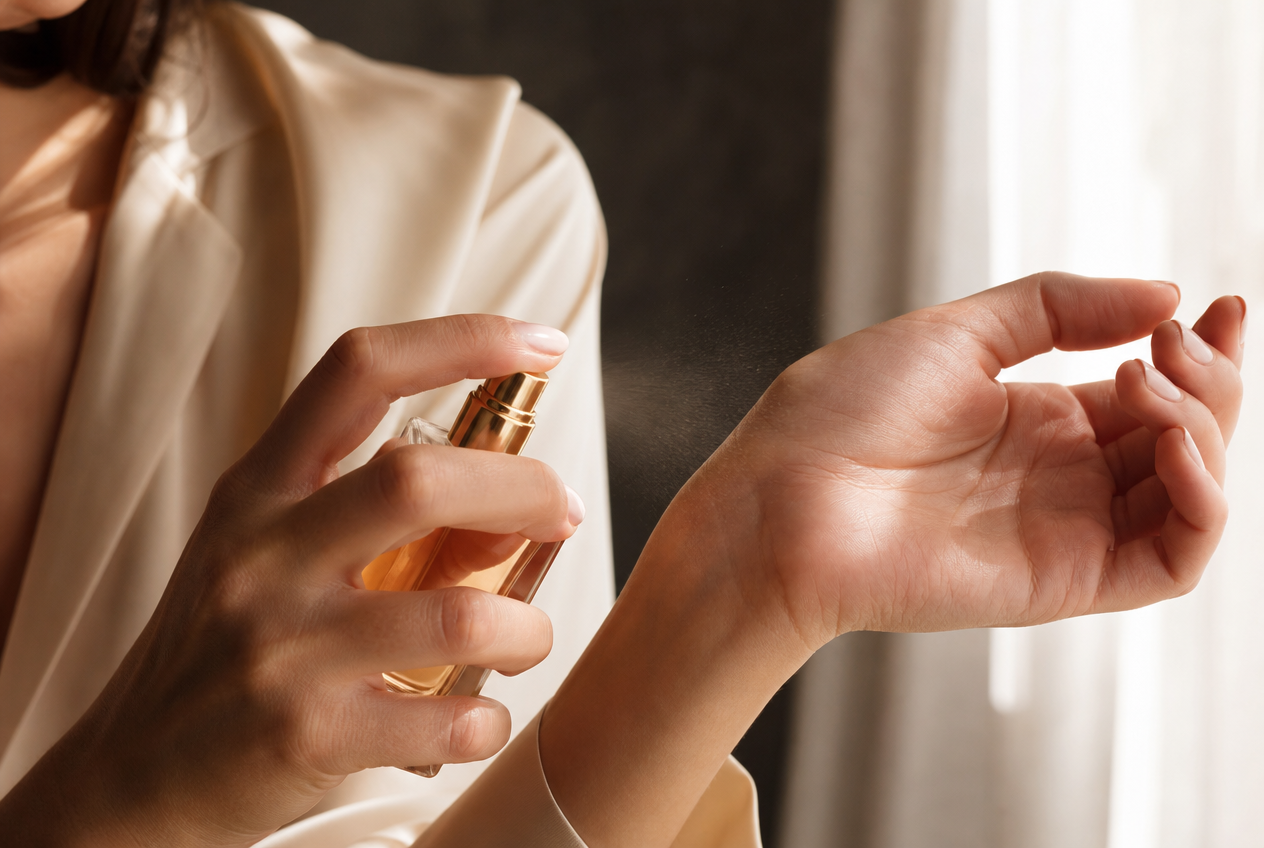
Test on skin, then wait several hours. The drydown tells you what you will genuinely be wearing.
Wealth without wellness is incomplete, and a signature scent is not something you buy. It is something your skin makes with you.
Common Questions About Skin Chemistry and Fragrance
Direct answers to what comes up most, including where the honest response is that nobody has measured it.
The right fragrance behaves well on your skin. It is not the one that performed best on someone else.
Questions about wear and behaviour
Why does my perfume disappear after an hour?
Two explanations are likely. Dry skin gives fragrance oils little to bind to, so evaporation runs faster. Alternatively, you may have gone nose-blind, since the brain stops registering a constant smell. Ask someone else before assuming it has gone.
Does what I eat change how my perfume smells?
Diet can influence your natural body scent, which forms the backdrop any fragrance sits against. However, claims about specific foods producing specific fragrance effects are not well evidenced. Treat that advice as anecdote rather than established science.
Questions about men, women, and choosing scent
Is there a real difference between perfume and cologne?
Only in concentration. Cologne describes a lighter dilution, while parfum describes the most concentrated. The association between cologne and men is a marketing convention, not a formulation difference. Anyone can wear either.
Should men and women choose fragrance differently?
Not in principle, though skin behaviour differs on average. Higher sebum output means scent often anchors longer on male skin, so a lighter concentration may be sufficient. Beyond that, the same testing approach serves everyone equally well.
Sources and research references
James AG, Austin CJ, Cox DS, Taylor D, Calvert R. Microbiological and biochemical origins of human axillary odour. FEMS Microbiology Ecology. 2013;83(3):527-540 | Barzantny H, Brune I, Tauch A. Molecular basis of human body odour formation: insights deduced from corynebacterial genome sequences. Trends in Microbiology. 2013
Callewaert C, Kerckhof FM, Granitsiotis MS, Van Gele M, Van de Wiele T, Boon N. Mapping axillary microbiota responsible for body odours using a culture-independent approach. Microbiome. 2015;3:3. doi:10.1186/s40168-014-0064-3 | Exploring the interrelationship between the skin microbiome and skin volatiles: a pilot study. Frontiers in Ecology and Evolution. 2023;11:1107463. doi:10.3389/fevo.2023.1107463
The information in this guide is for educational purposes and reflects research current to mid-2026. Fragrance longevity guidance reflects formulation principles rather than clinical trial evidence. Please consult a qualified dermatologist if you experience irritation from a fragranced product.
Rooted in Care. Refined in You.
Explore Belldiva’s Curated Collection
Over 70 luxury brands across beauty, skincare, grooming, and wellness. Every brand chosen for genuine excellence and real results.
Belldiva’s Curated Beauty and Wellness Brands
All Belldiva Brands
Huda Beauty
Charlotte Tilbury
Sephora
MAC
Dior
Katini Skin
Ultra Violette
NYX Cosmetics
The Ordinary
Verb Products
BK Beauty
Prada Beauty
Estée Lauder
Vasanti Cosmetics
Brickell
Lumin
Blu Atlas
Liomen
Jaxon Lane
Beardbrand
Scotch Porter
Bevel
Menfirst
Atlas
SkinCeuticals
Lululemon
Mindful
Headspace
Calm
Fitbit
MyFitnessPal
Noom
Peloton App
Organifi
Ritual
HUM Nutrition
Nike
YSL (Saint Laurent Beauty)
Lancôme
Clinique
NARS
Elizabeth Arden ✦
Victoria Beckham Beauty
Make Up For Ever
Valentino Beauty
Bobbi Brown
Shiseido
Benefit Cosmetics
Smashbox
Kylie Cosmetics
Urban Decay
Sigma Beauty
Stila ✦
Clarins
Tarte Cosmetics
PUR Cosmetics
Glossier
Elemis London
Kiehl’s
Murad
Paula’s Choice
Viori Beauty ✦
Life Extension
Lumen
Fiji Water
Anastasia Beverly Hills
Serious Skincare
Qure Skincare
Armani Beauty
Dr. Brandt ✦
skin chemistry and fragrance
fragrance
perfume
cologne
skin microbiome
fragrance longevity
scent
Belldiva fragrance