
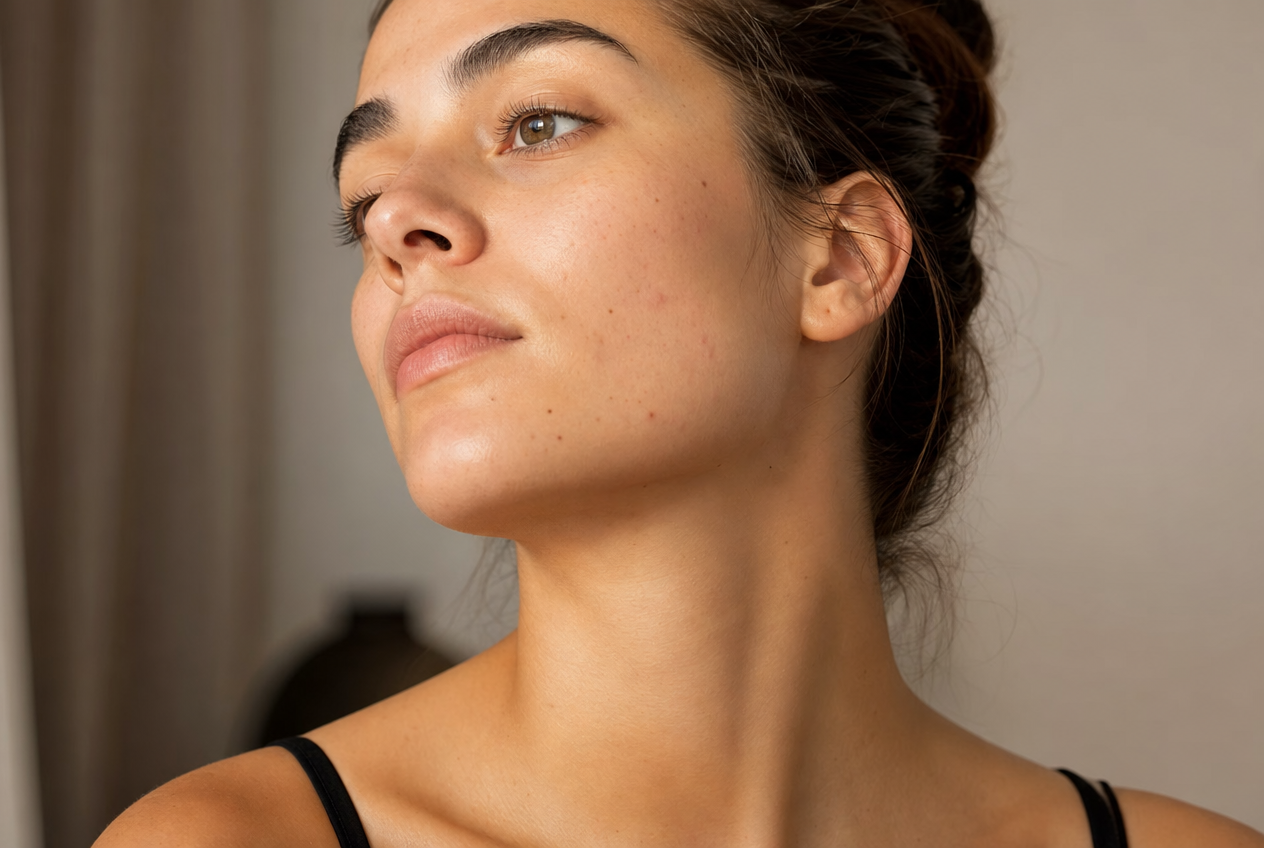
Face Mapping: What Your Breakouts Actually Tell You
Face mapping acne charts promise that location reveals the cause. The largest clinical studies tell a different and more useful story, for men and women alike.
Acne
Hormones
Men & Women
By Belldiva Editorial • 2026 • 12–14 min read
A breakout appears along your jaw, and the internet has an answer ready. Face mapping acne charts will tell you it is hormonal. Another chart will link your forehead to digestion and your cheeks to your lungs.
The appeal is obvious. A frustrating, unpredictable problem suddenly has a tidy explanation and a diagram to match. Unfortunately, the clinical evidence does not support the diagram. It does not support the part most people believe hardest either.
This guide covers what the largest studies actually found about where acne appears. It separates the claims with no mechanism from the ones with real data behind them. Crucially, it also explains what your breakout location genuinely can tell you, because the honest answer is still useful.
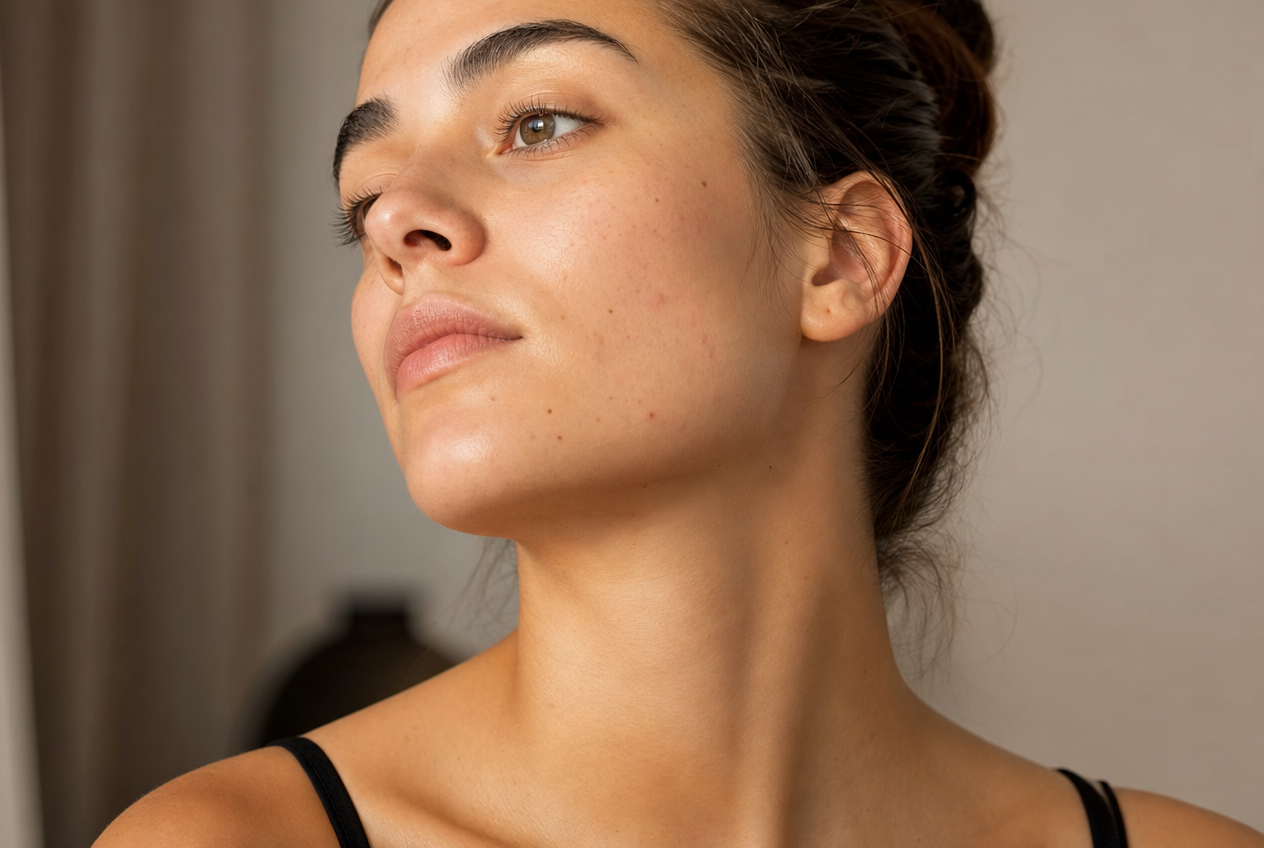
Where a breakout appears feels meaningful. The research shows it means something quite different from what the charts claim.
What Face Mapping Acne Charts Actually Claim
Before testing the idea, it helps to know where it came from and what it is really asserting.
The origin of the diagram
The zone charts circulating online trace back to traditional Chinese and Ayurvedic practice. Those systems connect regions of the face to internal organs. A blemish on the nose points to the heart, and the forehead reports on digestion.
These traditions are ancient and culturally significant. However, cultural longevity is not the same as clinical evidence. No peer-reviewed research has established a pathway linking a specific organ to a specific patch of facial skin.
Why the organ claims fail
Acne forms in the pilosebaceous unit, the follicle and its oil gland. Its drivers are well characterised: excess sebum, follicular blockage, bacteria, and inflammation. Notably, none of those mechanisms varies by which organ sits beneath a facial zone.
Blood supply and nerve routing do not create organ-to-zone reporting either. Therefore the modern version of face mapping acne rests on an appealing metaphor rather than a demonstrated mechanism.
Of adult women in a 374-participant international study had acne across multiple facial zones, not one (Dréno, JEADV)
Of that same group had acne confined to the jawline, the pattern popularly assumed to be typical
Participants photographed and graded by dermatologists in a population study that found severity unrelated to location
A chart that explains everything usually explains nothing. The useful information sits in what your skin does over time, not in which zone it does it.
The Jawline Rule Does Not Hold Up Either
This is the surprising part, because the jawline claim is the one even sceptics tend to accept.
What the largest study found
Dréno and colleagues published an international multicentre study in the Journal of the European Academy of Dermatology and Venereology. Dermatologists examined 374 adult women with acne across multiple countries. It remains one of the field’s clearest looks at where acne actually appears.
The results ran against the stereotype. Nearly 90 percent of participants had acne spread across several facial areas, including the forehead, cheeks, temples, and jaw. Only 11.2 percent had it confined to the jawline region.
The authors stated the conclusion plainly. They found the stereotype of acne appearing only along the jaw was not supported in most of this group. Moreover, 93.7 percent had comedones, which the hormonal narrative tends to overlook entirely.
Population data agrees
A separate population-based study photographed and graded 478 adults with facial acne. Dermatologists assessed standardised images rather than relying on self-report. Lesions appeared most often on the chin and least often on the nose.
One finding matters more than the ranking. Acne severity showed no relationship to where lesions appeared. In other words, location did not predict how bad the acne was. That is precisely what a diagnostic map would need to do.
What the Evidence Supports vs What It Does Not
Supported
Androgens increase sebum production
Facial oil glands respond more than body skin
Friction and contact cause localised breakouts
Not supported
Organ-to-zone connections on the face
Jawline location proving a hormonal cause
Any zone chart used as a diagnosis
Hormones genuinely drive acne. What the data rejects is the idea that a zone on your face can prove it.
The hormonal biology that is real
None of this means hormones are irrelevant. A 2024 review in the Journal of Dermatological Treatment confirms that androgens drive sebum production. That process underlies acne in everyone. That mechanism is thoroughly established.
Foundational work by Thiboutot and colleagues added another piece. Facial oil glands convert testosterone more actively than glands on the arm or abdomen. Consequently the face as a whole is androgen-sensitive. That research compared the face with the body, though, not one facial zone against another.
The distinction matters enormously. Androgen-driven acne is real for both men and women. The Belldiva hormone skincare routine guide covers how to work with it. Nevertheless, a jaw breakout on its own cannot confirm that hormones are the cause.

Phone contact, chin straps, and helmet lines produce genuinely localised breakouts. That is location telling you something real.
What Your Breakout Location Genuinely Tells You
Location is not meaningless. It simply points outward at what touches your skin, rather than inward at your organs.
✦
Friction and pressure leave a signature
Dermatology recognises acne mechanica, caused by sustained rubbing or pressure. Chin straps, helmets, sports equipment, face coverings, and a phone held against the cheek all produce it. Here the pattern really does trace the cause, because it follows the contact.
✦
The hairline reflects what is in your hair
Waxy styling products migrate onto the forehead and temples. Breakouts that trace the hairline often follow a product change rather than anything internal. The Belldiva scalp health guide explains how scalp care and facial skin overlap.
✦
Shaving irritation concentrates on the jaw
For men, jaw and neck bumps are frequently shaving-related rather than hormonal. Blunt blades and poor technique cause folliculitis and ingrown hairs that resemble acne. The Belldiva men’s skincare guide covers post-shave barrier care in detail.
✦
Product application follows your hands
Breakouts clustering exactly where you apply a rich cream suggest the formula, not your digestion. Introduce products one at a time to see the pattern clearly. Paula’s Choice and Murad both offer lighter targeted options.
Your breakout location does carry information. It points outward at what touches your skin, not inward at your liver.
Reading Your Skin Without Face Mapping Acne Charts
A better method exists, and it relies on patterns over time rather than a diagram.
Track timing, not zones
Hormonal patterns reveal themselves through timing and consistency. Breakouts that recur on a predictable cycle suggest a hormonal driver far more reliably than any location does. Note when lesions appear rather than only where.
Additional signs carry more weight than a map. Irregular cycles, unusual hair growth, or sudden changes in oiliness all point toward an endocrine cause. Those warrant a medical assessment rather than a chart.
Change one thing at a time
Most breakout mysteries resolve through methodical testing. Introduce a single new product and give it several weeks. If you change three things at once, the pattern becomes unreadable.
Consider contact factors alongside products. Pillowcases, phone screens, sports equipment, and headwear all touch the face repeatedly. In practice, these explain far more localised breakouts than any internal theory does.
Useful Signals vs Worth Ignoring
Pay attention to
Timing and recurrence ✓
What physically touches that area ✓
Recent product changes ✓
Set aside
Organ-to-zone diagrams ✗
Location as a diagnosis ✗
Self-diagnosing from a chart ✗

Tracking timing and product changes over weeks tells you far more than any zone diagram can.
Wealth without wellness is incomplete, and skin worth caring for deserves better than a diagram that guesses.
Common Questions About Face Mapping Acne
Direct answers to what comes up most, including where the honest response is to see a professional.
Questions about the charts themselves
Does face mapping have any scientific basis?
The organ-to-zone version has none in modern dermatology. No research establishes a pathway from an internal organ to a specific facial region. Location can still reflect external causes such as friction or product contact. That is a much narrower claim.
Does jawline acne always mean hormonal acne?
No. An international study of 374 adult women found only 11.2 percent had acne confined to the jaw. Nearly 90 percent had it across several zones. Hormones genuinely influence acne, but jaw location alone does not confirm them as the cause.
Questions about men, women, and next steps
Do these patterns differ between men and women?
The underlying biology is shared, since androgens drive sebum production in everyone. Men more often see jaw and neck irritation from shaving, while women more often notice cycle-linked timing. Neither pattern makes a zone chart diagnostic.
When should I stop guessing and see someone?
See a dermatologist if breakouts are painful, deep, scarring, or persist despite careful changes. Also seek advice if acne arrives alongside irregular cycles or unusual hair growth. A proper assessment identifies causes that no chart can detect.
Sources and research references
Dréno B, Thiboutot D, Layton AM, et al. Large-scale international study enhances understanding of an emerging acne population: adult females. Journal of the European Academy of Dermatology and Venereology. 2015;29(6):1096-1106. doi:10.1111/jdv.12757 (n=374, international multicentre, dermatologist examination)
Prevalence and characteristics of adult female acne: a cross-sectional population-based study. Acta Dermato-Venereologica. 2025 (n=478 with facial acne, dermatologist-graded standardised photography) | Del Rosso JQ, Kircik L. The cutaneous effects of androgens and androgen-mediated sebum production in acne vulgaris. Journal of Dermatological Treatment. 2024;35(1):2298878
Thiboutot D, Harris G, Iles V, Cimis G, Gilliland K, Hagari S. Activity of type 1 5 alpha-reductase exhibits regional differences in isolated sebaceous glands and whole skin. Journal of Investigative Dermatology. 1995;105(2):209-214 (foundational study comparing facial with non-facial skin)
The information in this guide is for educational purposes and reflects research current to mid-2026. It does not constitute medical advice. Please consult a qualified dermatologist for persistent, painful, or scarring acne, or any skin concern specific to you.
Rooted in Care. Refined in You.
Explore Belldiva’s Curated Skincare Collection
Over 70 luxury brands across skincare, makeup, and wellness. Every brand chosen for genuine excellence and real results.
Belldiva’s Curated Beauty and Wellness Brands
All Belldiva Brands
Huda Beauty
Charlotte Tilbury
Sephora
MAC
Dior
Katini Skin
Ultra Violette
NYX Cosmetics
The Ordinary
Verb Products
BK Beauty
Prada Beauty
Estée Lauder
Vasanti Cosmetics
Brickell
Lumin
Blu Atlas
Liomen
Jaxon Lane
Beardbrand
Scotch Porter
Bevel
Menfirst
Atlas
SkinCeuticals
Lululemon
Mindful
Headspace
Calm
Fitbit
MyFitnessPal
Noom
Peloton App
Organifi
Ritual
HUM Nutrition
Nike
YSL (Saint Laurent Beauty)
Lancôme
Clinique
NARS
Elizabeth Arden ✦
Victoria Beckham Beauty
Make Up For Ever
Valentino Beauty
Bobbi Brown
Shiseido
Benefit Cosmetics
Smashbox
Kylie Cosmetics
Urban Decay
Sigma Beauty
Stila ✦
Clarins
Tarte Cosmetics
PUR Cosmetics
Glossier
Elemis London
Kiehl’s
Murad
Paula’s Choice
Viori Beauty ✦
Life Extension
Lumen
Fiji Water
Anastasia Beverly Hills
Serious Skincare
Qure Skincare
Armani Beauty
Dr. Brandt ✦
face mapping acne
acne
jawline breakouts
hormonal acne
skin science
acne mechanica
skincare myths
Belldiva skincare