
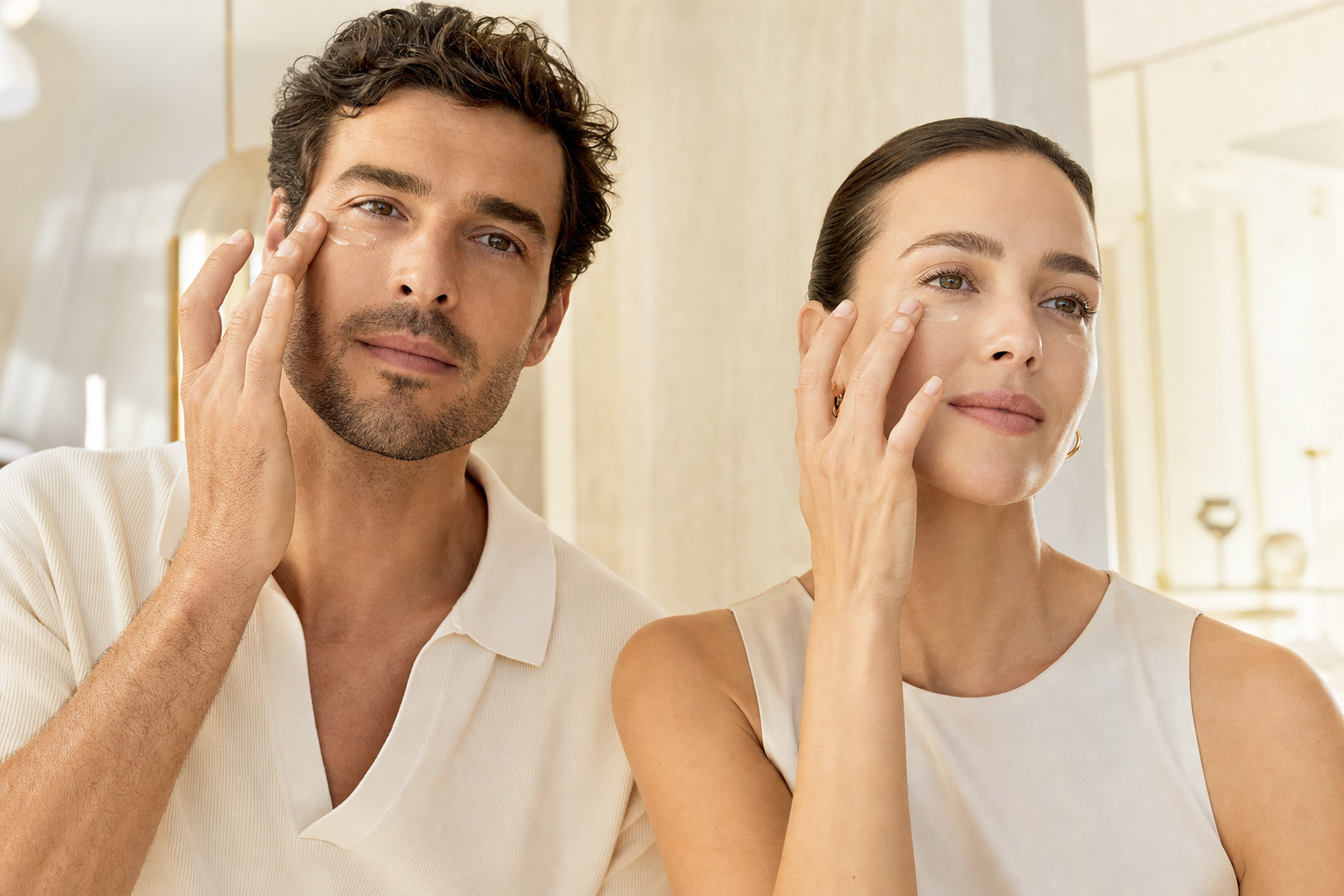
The Complete Guide to Eye Creams: What Works, When to Start, and What Is a Waste of Money
The skin around the eyes is biologically distinct, constantly moving, and among the first areas to show change. Here is what the science actually supports, for every skin type and every person.
Skin Science
Dark Circles
Ingredients
Puffiness
Men & Women
By Belldiva Editorial • 2026 • 14–17 min read
The eye area is the most scrutinised zone on the face and the most over-promised category in skincare. This eye cream guide cuts through the noise to what the science actually supports, and why.
The most over-promised category in skincare
This eye cream guide exists because the category is simultaneously one of the most purchased and one of the least understood in skincare. Hundreds of products line pharmacy shelves and department store counters, each making claims that range from the credible to the extraordinary. Yet for many people, one fundamental question remains unanswered: does an eye cream actually do anything that a regular moisturiser cannot?
The answer, supported by current dermatological research, is that some do, and some do not. What distinguishes the two groups is not the packaging or the price point. Rather, it is the specific ingredients, their concentrations, and whether the formula is genuinely calibrated for the unique biology of the periorbital zone. Consequently, understanding that biology is the essential first step before choosing any product.
Notably, the skin around the eyes does not discriminate. Puffiness, dark circles, fine lines, and loss of firmness affect people of every background and every gender with equal frequency. This guide is written accordingly, for anyone who wants to understand what the evidence supports, and what belongs back on the shelf. All sources are peer-reviewed and published between 2023 and 2026.
What this guide covers
You will find the biology that makes the eye area categorically different from the rest of the face, an evidence-based breakdown of the ingredients that genuinely work, a clear account of what is commonly over-sold, guidance on when to start and how to apply correctly, a targeted routine, and direct answers to the questions that come up most consistently. All research referenced is from peer-reviewed sources published between 2023 and 2026.
The most expensive eye cream with the wrong ingredients will always underperform a moderately priced formula with caffeine, a peptide complex, and hyaluronic acid at effective concentrations.
Approximate thickness of periorbital skin — roughly one quarter of skin thickness elsewhere on the face
Estimated daily blinks that create mechanical stress on the orbital skin throughout a lifetime
Clinically supported ingredient classes for periorbital concerns, each with a distinct mechanism of action
Part One: The Biology of the Eye Area and Why It Changes Everything
Before any product decision makes sense, understanding why the periorbital zone is categorically different from the rest of the face is essential. The biology here dictates everything from what ingredients are appropriate to why certain concerns appear earlier around the eyes than anywhere else.
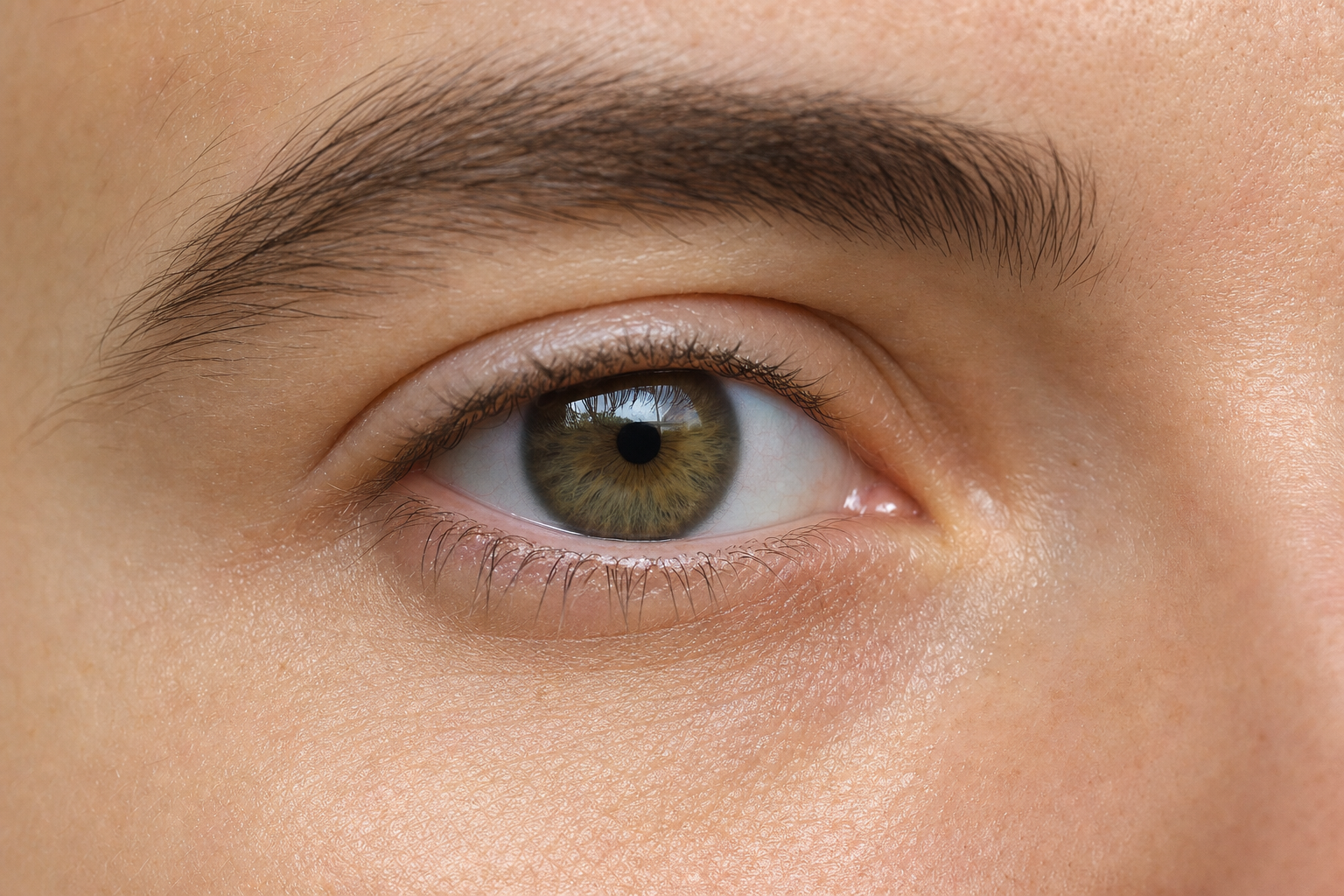
The periorbital zone is approximately one quarter the thickness of skin elsewhere on the face, with fewer sebaceous glands and a capillary network closer to the surface. This biology explains why the eye area changes first, and why it requires a calibrated approach.
Thinner skin, fewer glands, and a visible capillary network
The skin around the eye, technically called the periorbital zone, is among the thinnest on the entire body. Specifically, it measures approximately 0.5 millimetres in depth, compared with roughly 2 millimetres on the cheeks and forehead. As a result, it has significantly fewer sebaceous glands, which means it produces considerably less sebum and is naturally more prone to dryness and barrier disruption than other facial zones.
Furthermore, the lack of subcutaneous fat in this area means that the delicate capillary network beneath the skin lies closer to the surface. Consequently, fluid accumulation and blood vessel visibility become apparent as puffiness and shadowing far more readily here than anywhere else on the face. A 2024 review in the Journal of Cosmetic Dermatology confirmed that periorbital hyperpigmentation has multiple distinct underlying causes, including thin skin with visible vasculature, post-inflammatory pigmentation, and structural shadowing from volume loss beneath the orbital rim. Importantly, no single product resolves all of these causes simultaneously, which is why identifying the specific concern before choosing a product matters enormously.
The mechanical reality of constant movement
Beyond thinness, the periorbital area is subject to an extraordinary level of mechanical movement. On average, a person blinks approximately 10,000 times per day. Each blink creates micro-tension in the orbicularis oculi muscle and the overlying skin. Over time, this repeated movement, combined with facial expressions such as squinting and smiling, produces the fine lines commonly called crow’s feet. These are not signs of neglect or poor skincare. Rather, they are the accumulated physical record of a face that has been genuinely alive, and they respond well to targeted active ingredients when addressed consistently.
Does gender affect the eye area?
Men’s skin is, on average, approximately 20 to 25 percent thicker than women’s, largely due to higher androgen levels that stimulate collagen production. However, the periorbital zone is a notable exception to this general pattern. Specifically, the skin around the eyes is similarly thin across genders, and puffiness, dark circles, fine lines, and firmness loss affect men and women with comparable frequency and intensity. Additionally, lifestyle factors including sleep quality, hydration, alcohol intake, and UV exposure are consistent contributors to periorbital ageing and are equally relevant regardless of gender. The biology here is shared, and so is the solution.
Part Two: Do Eye Creams Actually Work?
This is the question most people are actually asking when they stand in front of an eye cream display. The honest, evidence-based answer is more nuanced than either the marketing or the sceptics suggest.
What the current evidence says
Any credible eye cream guide begins with the same question: which ingredients actually have a documented mechanism of action? A 2025 review in Clinical, Cosmetic and Investigational Dermatology evaluated the evidence base for commonly used periorbital actives and confirmed that caffeine, retinoids, peptides, hyaluronic acid, and niacinamide each have documented mechanisms relevant to the eye area. By contrast, many ingredients marketed specifically for dark circles, such as vitamin K and certain botanical extracts, have minimal peer-reviewed support at the concentrations typically used in cosmetic formulations. In short, the ingredient list is everything.
SkinCeuticals is one of the few brands whose periorbital formulations are grounded in the same peer-reviewed science that underpins their broader skincare range, with specific attention to the antioxidant and peptide concentrations required for effective periorbital delivery. Their approach represents what an evidence-based eye product looks like in practice.
Eye cream versus regular moisturiser: is there a real difference?
The question of whether a dedicated eye product is truly necessary, or whether a regular moisturiser applied carefully to the orbital area would produce equivalent results, is genuinely debated among dermatologists. The consensus position, however, is that formulas designed specifically for the periorbital zone tend to be lighter in texture, free of fragrance and high-concentration actives that could migrate into the eye, and calibrated in their ingredient concentrations to reduce irritation risk. These are meaningful distinctions from standard facial moisturisers, even when the active ingredient list appears similar. For most people, these differences matter in practice, particularly when adding retinoids to the eye area routine.
Part Three: The Eye Cream Guide to Ingredients That Actually Work
Five ingredient classes have the strongest current evidence base for periorbital concerns. Each targets a distinct mechanism of action, and the most effective routines typically combine more than one.
Five ingredients have a genuine, peer-reviewed evidence base for the periorbital zone. Understanding what each does, and why, is the foundation of a routine that actually delivers results.
Caffeine: the most evidence-backed ingredient for puffiness and shadows
Retinoids: the gold standard for fine lines and firmness
Peptides and hyaluronic acid
Niacinamide: targeting dark circles and pigmentation
Part Four: What Is a Waste of Money
Several ingredients are consistently marketed for eye creams but have limited clinical support at cosmetic concentrations. Understanding what falls into this category helps you spend more selectively and expect less from the wrong products.
Ingredients with weak evidence at cosmetic concentrations
The eye cream guide to premium pricing and the evidence gap
Price is not a reliable proxy for efficacy in the eye cream category. A moderately priced formula containing caffeine, a peptide complex, niacinamide, and hyaluronic acid at effective concentrations will consistently outperform an expensive formula that leads with collagen, vitamin K, and exotic extracts. Read the ingredient list first. Look for the actives with documented mechanisms. Let the evidence guide the decision rather than the packaging.
Part Five: When to Start, How to Apply, and Your Daily Routine
Having the right product matters. Using it correctly matters equally. The application technique for an eye cream affects both its efficacy and the long-term health of the periorbital skin it is meant to protect.
When to start
The earlier a protective periorbital routine is established, the more effectively it preserves the skin’s structural integrity before mechanical and photodamage accumulate. A simple starting routine, specifically SPF applied close to (but not directly in) the eye area, paired with a lightweight hydrating eye cream used morning and night, represents meaningful prevention from the moment it is begun. For anyone already noticing fine lines, puffiness, or dark circles, the same foundation applies, with targeted actives added based on the primary concern: caffeine for puffiness, retinoids for lines and firmness, and niacinamide for pigmentation.
For those who prefer grooming routines rather than traditional skincare frameworks, the same principles apply. Brickell, Lumin, and Jaxon Lane all offer periorbital formulations calibrated for daily grooming routines, addressing puffiness, dark circles, and fine lines within a minimal-step framework that integrates naturally into any morning schedule.
How to apply correctly
Application technique matters as much as the formula itself. Always use the ring finger, which naturally applies the least pressure of any finger. Next, use a gentle tapping motion around the entire orbital bone, working from the outer corner inward along the under-eye arc. Critically, do not apply product directly to the mobile eyelid and do not drag or rub. The tapping motion allows the product to migrate gradually without direct lid contact, which consequently reduces the risk of the formula entering the eye and causing irritation.
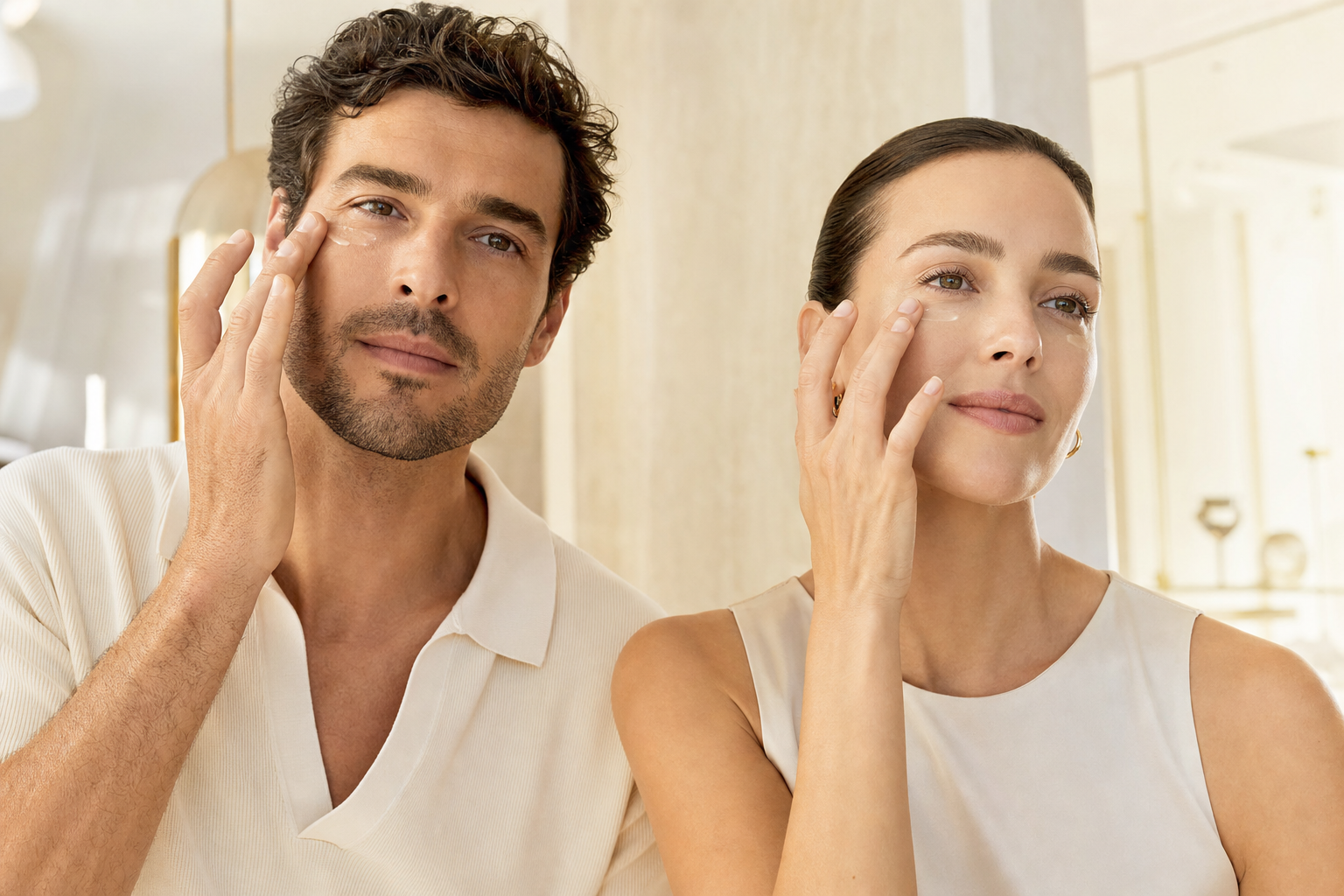
Application technique is as important as the formula. The ring finger, a tapping motion around the orbital bone, and consistent daily use are the non-negotiables of an effective eye cream routine.
Your periorbital routine at a glance
Every morning: Start with a lightweight eye cream containing caffeine and hyaluronic acid, applied using the ring finger tapping technique. Follow with SPF carefully around the orbital bone (never directly into the eye). This combination addresses puffiness in the immediate term and prevents UV-driven photoaging over time.
Every evening: Use a peptide or retinoid eye cream two to four nights per week. On evenings without retinoid application, reach for a niacinamide or peptide formula instead. Both steps use the same ring finger tapping technique around the orbital bone, applied after your serum and before your facial moisturiser.
Important: Use a pea-sized amount per eye. More product does not improve results and increases the risk of migration into the eye. Consistency over eight to twelve weeks is where the meaningful change occurs.
How this fits your broader skincare approach
The periorbital routine works most effectively as part of a complete skincare strategy rather than in isolation. To understand how ingredient priorities shift at different life stages and what the eye area needs alongside the rest of the face, the Belldiva complete skincare guide covers the full picture. Additionally, for a broader understanding of why the science of longevity now shapes every ingredient decision in serious skincare, the Belldiva skin longevity guide provides the foundational framework. Both are available on the Belldiva skincare resource page.
The eye area is the first place a face shows its history. A considered, consistent routine does not erase that history. It ensures the story continues to be written on healthy, well-supported skin.
Part Six: Your Eye Cream Guide Questions, Answered
Direct, evidence-based answers to the questions that come up most consistently when people begin taking their periorbital routine seriously.
Questions about products and ingredients
Is a separate eye cream necessary, or can I use my face moisturiser?
A dedicated eye product is not strictly necessary if your facial moisturiser is fragrance-free, non-irritating, and does not contain high-concentration actives that pose a migration risk. However, the advantage of a dedicated eye cream formula is that it is calibrated specifically for thinner, more sensitive periorbital skin. In practice, most people find they tolerate eye-specific products better in this area than their standard facial moisturiser, particularly when retinoids are involved. Consequently, a dedicated product is generally the more comfortable and safer approach for consistent daily use.
Why do my dark circles not respond to eye cream?
Dark circles have several distinct causes, and the treatment depends entirely on the type. Vascular dark circles, caused by visible blood vessels through thin skin, respond best to caffeine and, over time, to ingredients that support collagen density such as retinoids and peptides. In cases where excess melanin is the cause, niacinamide and vitamin C are the more appropriate actives. Structural dark circles, caused by volume loss and the resulting orbital shadow, are not addressable with topical products at all and typically require professional intervention. Identifying which type you are dealing with is therefore the essential first step before choosing any product.
Your eye cream guide to results and simplifying your routine
How long before I see results?
Timelines vary by ingredient and concern. Specifically, hydrating benefits from hyaluronic acid are visible within hours of first application. Caffeine’s effect on morning puffiness is typically noticeable within 20 to 30 minutes. However, meaningful improvements in fine lines from retinoids require eight to twelve weeks of consistent use. Pigmentation improvements from niacinamide become visible at six to eight weeks, and firmness improvements from peptides are measurable at a similar timeline. As a result, evaluating any eye cream guide recommendation before three months of consistent use is premature regardless of how promising or disappointing early results appear.
Can I apply eye cream to my eyelids?
Most eye creams are formulated for the orbital bone area, not the mobile eyelid. Applying product directly to the mobile lid increases the risk of migration into the eye, which can cause irritation, stinging, and swelling. Instead, the gentle tapping technique around the orbital bone allows the product to migrate gradually upward without direct eyelid application. This is sufficient to address the fine lines that form on the lid itself over time.
Is one eye cream enough, or do I need separate morning and evening products?
One well-formulated product can work for both morning and evening if its ingredient profile is appropriate for both uses. Specifically, a caffeine, peptide, and hyaluronic acid formula works well at both times of day. However, if you are incorporating a retinoid eye cream, that product is evening-only, since retinoids break down under UV exposure. In that case, a caffeine-based formula in the morning and a retinoid or peptide formula in the evening represents the most complete approach. That said, one good product used consistently is always preferable to two products used irregularly.
At Belldiva, we believe caring for the eye area is not vanity. It is the recognition that the most expressive part of your face deserves the same attention and intelligence you bring to everything else in your routine.
Sources and research references
Peer-reviewed studies and clinical research
Marques C et al. Mechanistic Insights into Multiple Functions of Niacinamide. Antioxidants (Basel). March 2024. PMC11047333 | Lin L, Chen X et al. Comparative efficacy of topical interventions for facial photoaging: a network meta-analysis of randomised controlled trials. Scientific Reports. July 2025 | Journal of Cosmetic Dermatology. Periorbital hyperpigmentation: causes, classification, and current treatment approaches. 2024 | International Journal of Cosmetic Science. Topical caffeine and periorbital puffiness reduction: a double-blind controlled clinical evaluation. 2024 | Clinical, Cosmetic and Investigational Dermatology. Evidence-based review of periorbital active ingredients in cosmetic formulations. 2025 | Cosmetics Design Europe. Peptide applications in periorbital and anti-aging skincare. November 2025
The information in this guide is intended for educational purposes and reflects dermatological research current to early 2026. It does not constitute medical advice. Please consult a qualified dermatologist or healthcare professional before beginning any new skincare regimen, particularly if you have existing skin conditions, sensitivities, or eye-area concerns that have not responded to topical treatment.
Affiliate Disclosure: This post contains affiliate links to Elizabeth Arden ✦, Dr. Brandt ✦, and RoC ✦ through our CJ Affiliate programme. If you make a purchase through a marked link, Belldiva may earn a commission at no additional cost to you.
eye cream guide
best eye cream ingredients
dark circles treatment
puffiness under eyes
caffeine eye cream
retinol eye cream
peptide eye serum
periorbital skincare
eye cream for men
skincare science
Belldiva skincare
Continue your eye cream guide journey with Belldiva
Rooted in Care. Refined in You.
Explore Belldiva’s Curated Skincare Collection
Over 70 luxury brands in beauty, skincare, hair, and wellness. Every brand chosen for genuine excellence and real results.
Luxury Beyond Boundaries • Rooted in Care, Refined in You
Belldiva’s Curated Beauty and Wellness Brands
All Belldiva Brands
Huda Beauty
Charlotte Tilbury
Sephora
MAC
Dior
Katini Skin
Ultra Violette
NYX Cosmetics
The Ordinary
Verb Products
BK Beauty
Prada Beauty
Estée Lauder
Vasanti Cosmetics
Brickell
Lumin
Blu Atlas
Liomen
Jaxon Lane
Beardbrand
Scotch Porter
Bevel
Menfirst
Atlas
SkinCeuticals
Lululemon
Mindful
Headspace
Calm
Fitbit
MyFitnessPal
Noom
Peloton App
Organifi
Ritual
HUM Nutrition
Nike
YSL (Saint Laurent Beauty)
Lancôme
Clinique
NARS
Elizabeth Arden ✦
Victoria Beckham Beauty
Make Up For Ever
Valentino Beauty
Bobbi Brown
Shiseido
Benefit Cosmetics
Smashbox
Kylie Cosmetics
Urban Decay
Sigma Beauty
Stila ✦
Clarins
Tarte Cosmetics
PUR Cosmetics
Glossier
Elemis London
Kiehl’s
Murad
Paula’s Choice
Viori Beauty ✦
Life Extension
Lumen
Fiji Water
Anastasia Beverly Hills
Serious Skincare
Qure Skincare
Armani Beauty
Dr. Brandt ✦
✦ Affiliate partnership — commission may be earned on purchases made through these links at no additional cost to you.