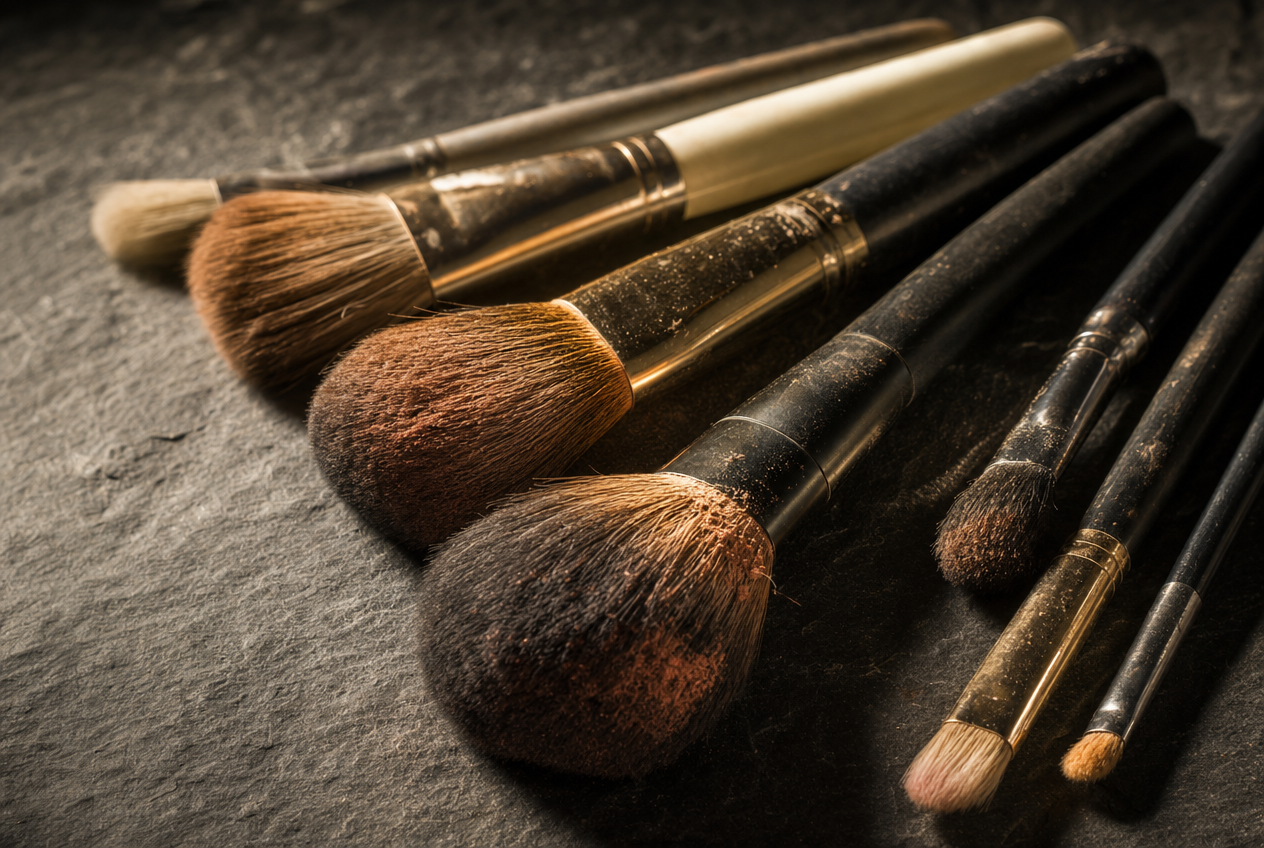
Your Makeup Brushes Are Dirtier Than You Think
Makeup brush cleaning is the least glamorous step in any routine. Peer-reviewed microbiology suggests it may also be one of the most consequential.
Hygiene
Skin Health
Men & Women
By Belldiva Editorial • 2026 • 11–13 min read
Makeup brush cleaning is the step almost everyone skips. It is tedious, it is invisible, and nothing appears to go wrong when you neglect it. Yet the microbiology on this is unusually clear, and it is not comfortable reading.
Researchers at Aston University tested donated, in-use cosmetic products and published the results in the Journal of Applied Microbiology. Between 79 and 90 percent carried bacterial contamination. Blending sponges were the worst offenders by a wide margin.
This guide covers what that research actually found. It explains why sponges and brushes behave so differently, and how to build a cleaning habit that holds. It also explains which claims circulating online have no real evidence behind them. Every study cited here is peer-reviewed and named, so you can check the work yourself.
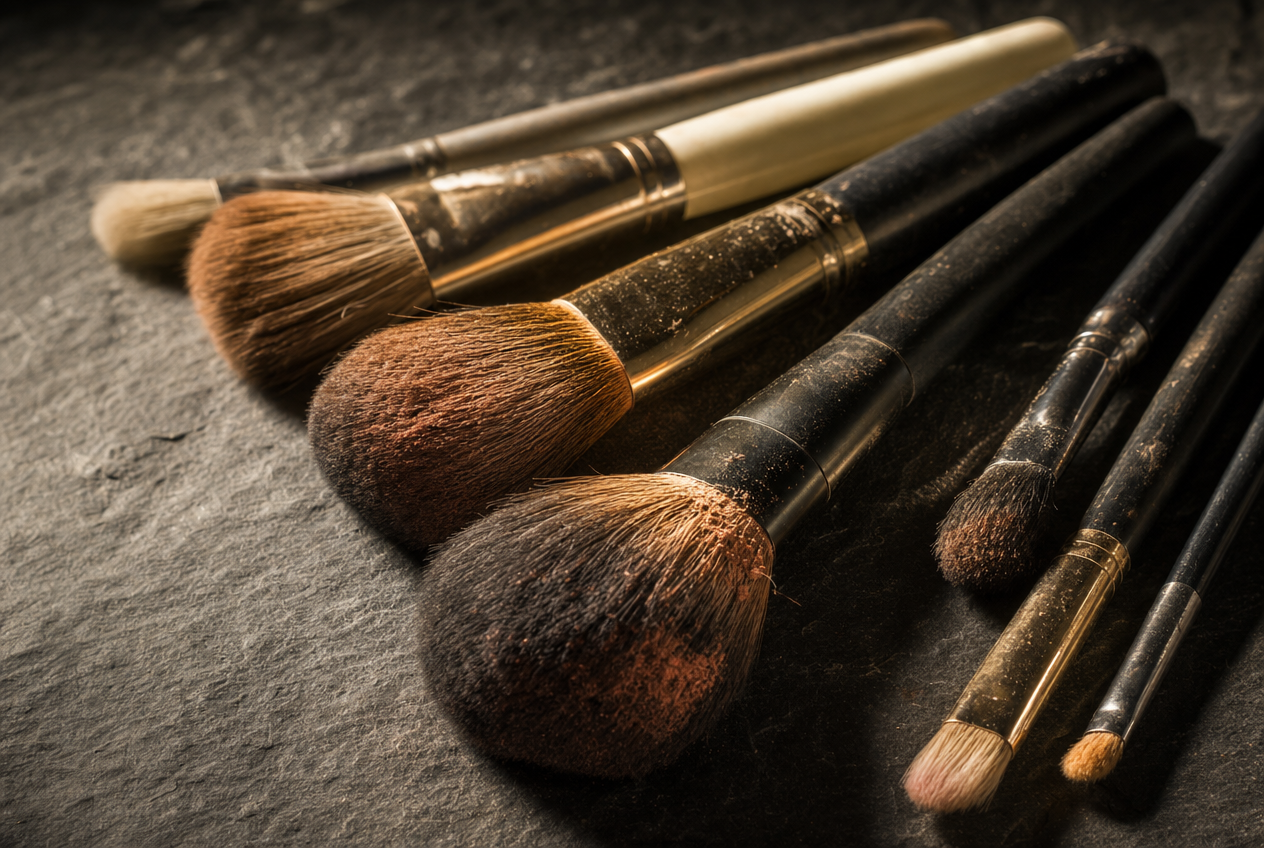
Brushes rarely look dirty enough to worry about. That is precisely the problem, since contamination is invisible at the scale that matters.
What the Research on Makeup Brush Cleaning Actually Found
Two independent studies, run years apart on different continents, reached remarkably similar conclusions.
The Aston University findings
Bashir and Lambert examined five categories of used cosmetics: lipstick, lip gloss, eyeliner, mascara, and blending sponges. Roughly 79 to 90 percent of everything tested carried bacteria. Most products showed loads between 100 and 1,000 colony-forming units per millilitre.
Blending sponges were different in kind, not just degree. They averaged over one million colony-forming units per millilitre, roughly a thousandfold higher than other products. The reason becomes obvious once you consider how they are used.
Why blending sponges are the worst offender
A sponge is designed to be used damp. Consequently, it stays damp, holds product deep inside its structure, and sits in a warm bathroom. That combination is close to ideal for bacterial growth.
User behaviour compounds the problem considerably. In the Aston study, 93 percent of sponges had never been cleaned. Furthermore, 64 percent had been dropped on the floor and used again anyway.
A separate study reached the same conclusion
Attar and Imam analysed 57 cosmetic brushes and sponges in Jeddah. Their work appeared in the International Journal of Microbiology in 2025. They used 16S rRNA gene sequencing to identify what was growing, a considerably more precise method than culture alone.
Gram-positive bacteria dominated at 81 percent, mostly Staphylococcus and Micrococcus species. Gram-negative Pseudomonas also appeared. Alongside the lab work, a survey of 370 participants found that 44.3 percent rarely cleaned their brushes at all.
Of used cosmetic products carried bacterial contamination (Bashir & Lambert, Journal of Applied Microbiology)
Of blending sponges in that study had never been cleaned even once
Of 370 surveyed participants rarely clean their brushes (Attar & Imam, International Journal of Microbiology, 2025)
Two studies, different countries, different methods, same answer. Your tools carry more than pigment, and almost nobody cleans them.
What This Means for Your Skin, Honestly
Here is where careful reading matters, because the honest answer is more nuanced than most coverage admits.
What the evidence supports
Some of the organisms found are genuinely opportunistic pathogens. Staphylococcus aureus, Escherichia coli, and Pseudomonas aeruginosa all appeared across these studies. Each is associated with skin infections when it reaches broken skin.
Risk rises meaningfully in specific situations. Applying product near the eyes, over active breakouts, or onto any cut or graze creates an entry point. People who are immunocompromised face higher risk again.
What the evidence does not yet prove
Now the part most articles leave out. The Jeddah study found no statistically significant link between cleaning frequency and reported skin problems. The p-value was 0.698, which is nowhere near significance.
That single finding deserves respect rather than burial. Contamination is thoroughly documented, but a direct causal line from dirty brushes to your breakouts has not been established. Much of what circulates online overstates this considerably.
The sensible reading sits between the two extremes. Your tools demonstrably carry opportunistic pathogens, and cleaning them is quick and free. Meanwhile, nobody should promise that a weekly wash will clear your skin.
Supported by Evidence vs Overstated Online
Well supported
Most used tools carry bacteria
Damp sponges carry dramatically more
Broken skin and the eye area raise real risk
Overstated or unproven
That dirty brushes directly cause acne
That cleaning frequency predicts skin problems
Precise percentages quoted without a named study
Makeup brush cleaning is worth doing on the evidence available. It is not a treatment, and no credible source should sell it as one.
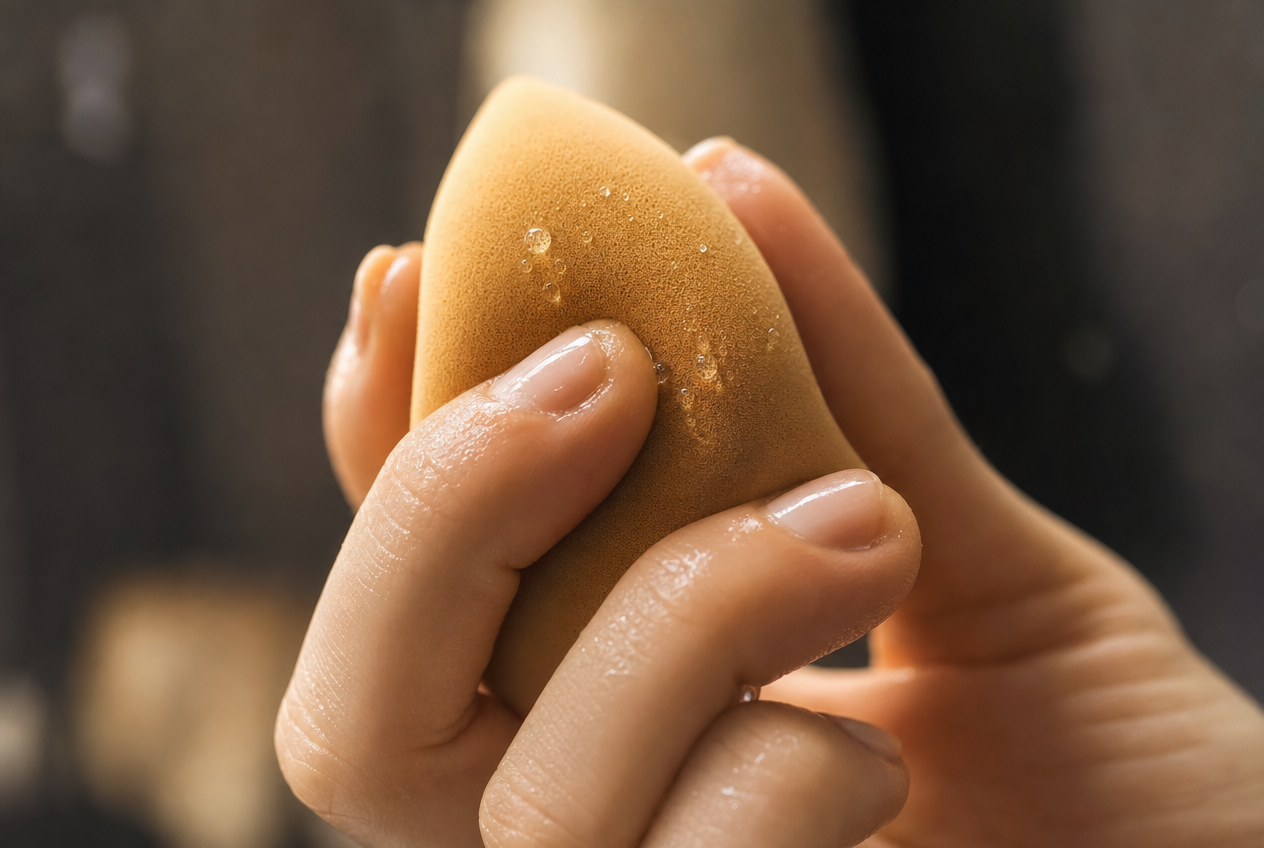
A damp sponge in a warm bathroom is the highest-risk item in most makeup bags. The margin is roughly a thousandfold.
A Makeup Brush Cleaning Method That Holds Up
The method matters less than the consistency. Still, a few details genuinely change the outcome.
✦
Wash with surfactant, not just water
Foundation and cream products are oil-based, so water alone will not lift them. A gentle shampoo or dedicated brush cleanser works because surfactants emulsify oil. Work the bristles against your palm, focusing near the base where pigment collects. BK Beauty and Sigma Beauty both make cleansers formulated for this.
✦
Dry flat, and dry completely
This step matters more than people expect. Drying upright lets water run into the ferrule, the metal collar holding the bristles. Trapped water dissolves the glue and creates a damp reservoir. Lay brushes flat with the bristles over an edge instead.
✦
Treat sponges as consumables
Given the contamination levels the research found, a sponge deserves different rules entirely. Wash it after every few uses, dry it somewhere ventilated rather than a closed drawer, and replace it regularly. If you drop one, throw it out.
✦
Stop sharing, and respect expiry
Giacomel and colleagues found that 61.4 percent of participants shared makeup with others. Sharing transfers a different person’s skin flora onto yours. Expired product compounds this, since preservative systems weaken over time.
A perfect routine you abandon in a fortnight protects nothing. A modest one you actually keep protects a great deal.
How Makeup Brush Cleaning Fits the Rest of Your Routine
Tools are one input among several. Here is how this connects to what you already do for your skin.
Your skin already hosts bacteria, and that is fine
Worth keeping perspective here. Your skin naturally carries trillions of microorganisms, and most are protective rather than threatening. As the Belldiva skin microbiome guide explains, the goal was never sterility.
The concern is different in nature. Dirty tools introduce organisms that do not belong on your face, in concentrations your skin never evolved to handle. That is a separate problem from your resident flora.
Barrier health changes the risk calculation
An intact barrier is remarkably good at keeping opportunistic bacteria out. A compromised one is not. As the Belldiva skin barrier repair guide covers, over-exfoliation and harsh cleansing both weaken that defence.
This is why the two habits reinforce each other. Clean tools reduce what lands on your skin, while a healthy barrier handles whatever still gets through. Neither replaces the other.
Routine Habit vs Worth a Doctor’s Visit
Normal maintenance
Weekly wash of face brushes ✓
Frequent sponge washing and replacement ✓
Retiring expired product ✓
See a professional
Eye pain, discharge, or vision changes ✗
A spreading, warm, or painful rash ✗
Any lesion that worsens rather than settles ✗
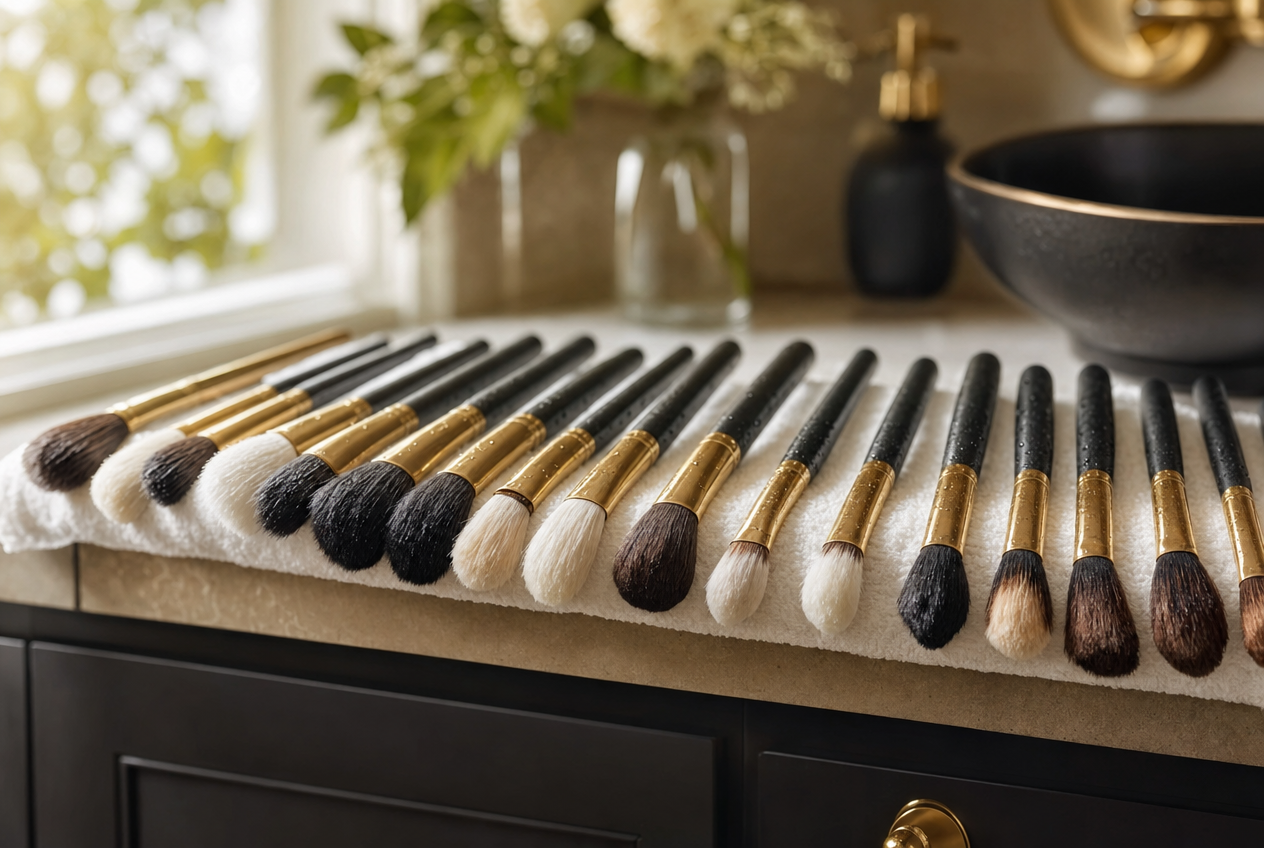
Drying flat with the bristles over an edge keeps water out of the ferrule. It is a small detail that meaningfully extends a brush’s life.
At Belldiva, we would rather tell you what the research supports and where it stops than sell you certainty that does not exist.
Common Questions About Makeup Brush Cleaning
Direct answers to what comes up most often, including where the honest answer is simply that nobody knows yet.
Questions about frequency and method
How often should I really wash my brushes?
No trial has established an optimal interval, so treat any precise number with suspicion. Weekly for anything used with liquid or cream products is a reasonable, widely recommended default. Powder brushes tolerate longer gaps, since dry product supports less growth.
Should I use alcohol to disinfect my brushes?
Alcohol disinfects but does not clean, since it has no meaningful ability to lift oil-based residue. It also dries out natural bristles over time. Many confident claims circulate about alcohol versus soap, yet very few trace back to real published research. Wash with surfactant first, and treat alcohol as optional.
Questions about skin and makeup brush cleaning habits
Will cleaning my brushes clear my breakouts?
Probably not on its own, and anyone promising otherwise is ahead of the evidence. The Jeddah study found no significant link between cleaning frequency and reported skin problems. Clean tools remain worth maintaining, but acne has many drivers, and tools are only one of them.
Does any of this apply to men?
Entirely, and it extends further than most men expect. Any applicator touching skin follows the same microbiology, including concealer brushes, tinted SPF sponges, and beard brushes. The organisms involved do not distinguish between users.
Sources and research references
Bashir A, Lambert P. Microbiological study of used cosmetic products: highlighting possible impact on consumer health. Journal of Applied Microbiology. 2020;128(2):598-605. doi:10.1111/jam.14479 | Attar RMS, Imam MA. Assessing the Levels and Types of Bacterial Contamination in Cosmetic Brushes: Implications for Beauty and Hygiene in Jeddah City. International Journal of Microbiology. 2025;2025:2128581. doi:10.1155/ijm/2128581
Giacomel CB, Dartora G, Dienfethaeler HS, Haas SE. Investigation on the use of expired make-up and microbiological contamination of mascaras. International Journal of Cosmetic Science. 2013;35(4):375-380. doi:10.1111/ics.12053 | Microbial Contamination in Cosmetic Products. Cosmetics. 2025;12(5):198. MDPI
The information in this guide is for educational purposes and reflects research current to mid-2026. It does not constitute medical advice. Please consult a qualified dermatologist or physician if you are experiencing a persistent skin or eye problem.
Rooted in Care. Refined in You.
Explore Belldiva’s Curated Makeup Collection
Over 70 luxury brands across makeup, skincare, and wellness. Every brand chosen for genuine excellence and real results.
Belldiva’s Curated Beauty and Wellness Brands
All Belldiva Brands
Huda Beauty
Charlotte Tilbury
Sephora
MAC
Dior
Katini Skin
Ultra Violette
NYX Cosmetics
The Ordinary
Verb Products
BK Beauty
Prada Beauty
Estée Lauder
Vasanti Cosmetics
Brickell
Lumin
Blu Atlas
Liomen
Jaxon Lane
Beardbrand
Scotch Porter
Bevel
Menfirst
Atlas
SkinCeuticals
Lululemon
Mindful
Headspace
Calm
Fitbit
MyFitnessPal
Noom
Peloton App
Organifi
Ritual
HUM Nutrition
Nike
YSL (Saint Laurent Beauty)
Lancôme
Clinique
NARS
Elizabeth Arden ✦
Victoria Beckham Beauty
Make Up For Ever
Valentino Beauty
Bobbi Brown
Shiseido
Benefit Cosmetics
Smashbox
Kylie Cosmetics
Urban Decay
Sigma Beauty
Stila ✦
Clarins
Tarte Cosmetics
PUR Cosmetics
Glossier
Elemis London
Kiehl’s
Murad
Paula’s Choice
Viori Beauty ✦
Life Extension
Lumen
Fiji Water
Anastasia Beverly Hills
Serious Skincare
Qure Skincare
Armani Beauty
Dr. Brandt ✦
makeup brush cleaning
makeup brushes
beauty blender
makeup hygiene
bacterial contamination
skin health
makeup tools
Belldiva makeup