The Quiet Psychology of a Skincare Ritual
A skincare ritual may steady you for reasons that have nothing to do with the formulas, and the behavioural research explaining why is genuinely surprising.
Wellbeing
Daily Habits
Men & Women
By Belldiva Editorial • 2026 • 11–13 min read
There are evenings when the routine does something the ingredients cannot account for. The day has been long and disordered, and then ten minutes at the sink returns you to yourself. Nothing about the serum explains that.
Behavioural science has studied why structured, repeated actions steady people. The findings are more specific than the wellness language around self-care usually suggests. Researchers have measured the effect using heart rate alongside self-report.
This guide covers what that research established. It includes one finding that may change how you see your own routine. A boundary is worth stating first, though.
The Boundary Worth Stating First
No study has tested whether a skincare routine specifically reduces anxiety. The research below examined rituals before public speaking, during grief, and around performance tasks. Applying it to a bathroom shelf is reasonable inference rather than demonstrated fact.
We are saying this upfront because the distinction matters. What follows is a well evidenced explanation for something you may already have noticed, not proof that washing your face treats anything.
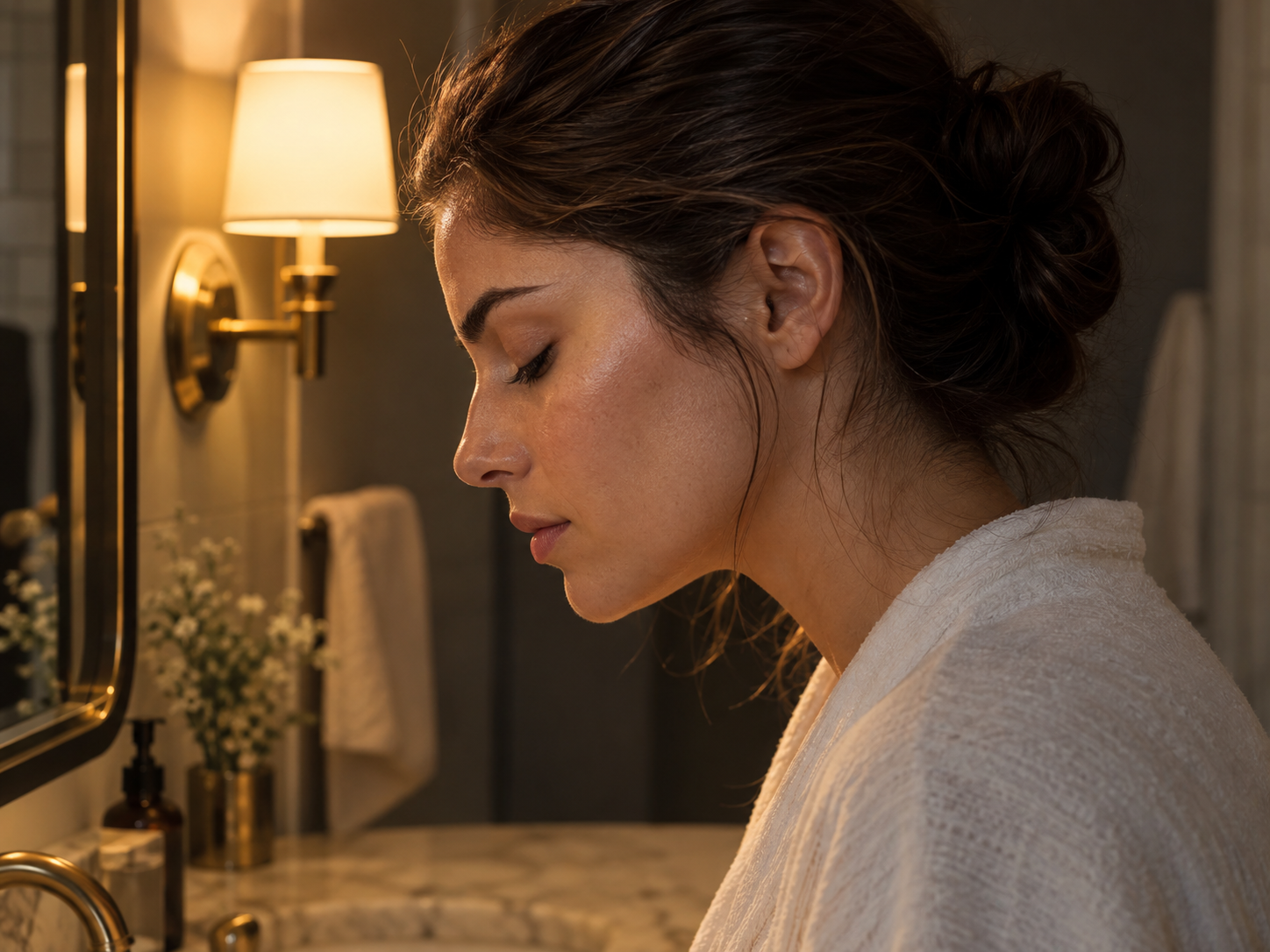
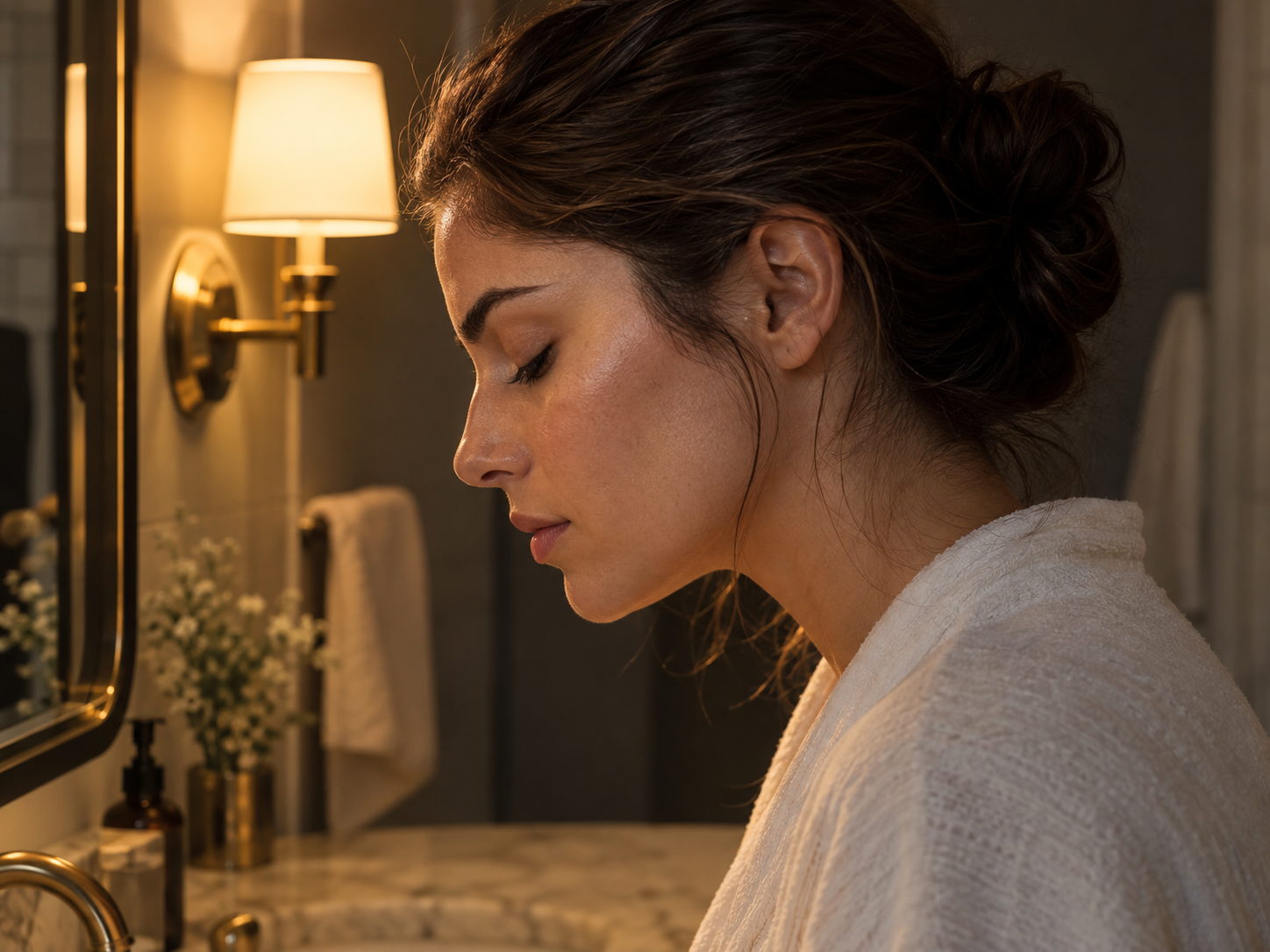
The same sequence, in the same order, at roughly the same hour. That structure is doing work of its own.
What the Ritual Research Found
Three studies matter here, and they used physiological measures rather than relying only on how participants said they felt.
Rituals before high-pressure moments
Brooks and colleagues published a series of experiments in Organizational Behavior and Human Decision Processes. Participants faced genuinely stressful tasks, including public singing and high-stakes mathematics.
Some performed a short structured sequence beforehand while others did not. Those who did showed reduced anxiety on both physiological and self-report measures. They also performed better as a result.
Measured in the field, not only the laboratory
A study in Philosophical Transactions of the Royal Society B took the question outside. Seventy-five participants underwent anxiety induction through public speaking. They then either performed a familiar ritual or simply sat and relaxed.
Researchers tracked heart rate variability alongside what participants reported feeling. The ritual condition showed greater anxiety reduction. That effect appeared in the physiological data rather than only in what people said.
The study that complicates the picture
Honesty requires including this one. A pre-registered study with 268 participants tested the same idea. People were assigned to ritualised action, a control activity, or nothing at all after anxiety induction.
Ritualised action did reduce anxiety. However, the reduction was only slightly larger than in the other two conditions. The clearest differences appeared among participants most affected by the anxiety induction to begin with.
That result does not overturn the earlier work, though it does temper it. The effect is real and it is modest. That is roughly what you would expect from ten minutes at a sink.
Participants in the pre-registered study testing ritualised action against control conditions
Participants in the field study measuring heart rate variability alongside self-report
Studies testing a skincare routine specifically, which is why we call this inference
The effect is real and it is modest. That is precisely what you would expect from ten minutes at a sink, and it is worth having anyway.
Why a Skincare Ritual Might Work This Way
Researchers have proposed a mechanism, and it explains why the effect appears when life feels least controllable.
Order imposed on disorder
The proposed mechanism concerns predictability. Researchers describe ritualised behaviour as reducing psychological entropy, meaning the disorganisation that uncertain situations produce in the mind.
A rigid, repetitive sequence offers something reliably predictable when little else is. That restores a sense of control. Such behaviours appear across cultures precisely when circumstances feel least controllable.
Related work by Norton and Gino examined people who had experienced loss. Rituals reduced grief and increased feelings of control. The pattern holds well beyond performance anxiety.
The finding that surprised us most
Brooks and colleagues tested something clever. They gave participants identical sequences of actions. Some were told this was a ritual, while others heard it described as random behaviour.
The label changed the outcome. Believing the sequence constituted a ritual was, in their words, a critical ingredient in reducing anxiety. The same actions performed without that framing did considerably less.
Consider what that implies for your evenings. Treating your routine as a deliberate ritual, rather than a chore, may genuinely alter what it does for you.
What the Evidence Supports vs What It Does Not
Well supported
Structured sequences reduce anxiety measurably
Predictability restores a sense of control
How you frame the actions changes the effect
Not established
That skincare routines specifically do this
That any product improves mood directly
That a routine substitutes for real support
This is a small daily good, not a treatment. If you are struggling, please speak with your doctor or a qualified professional.
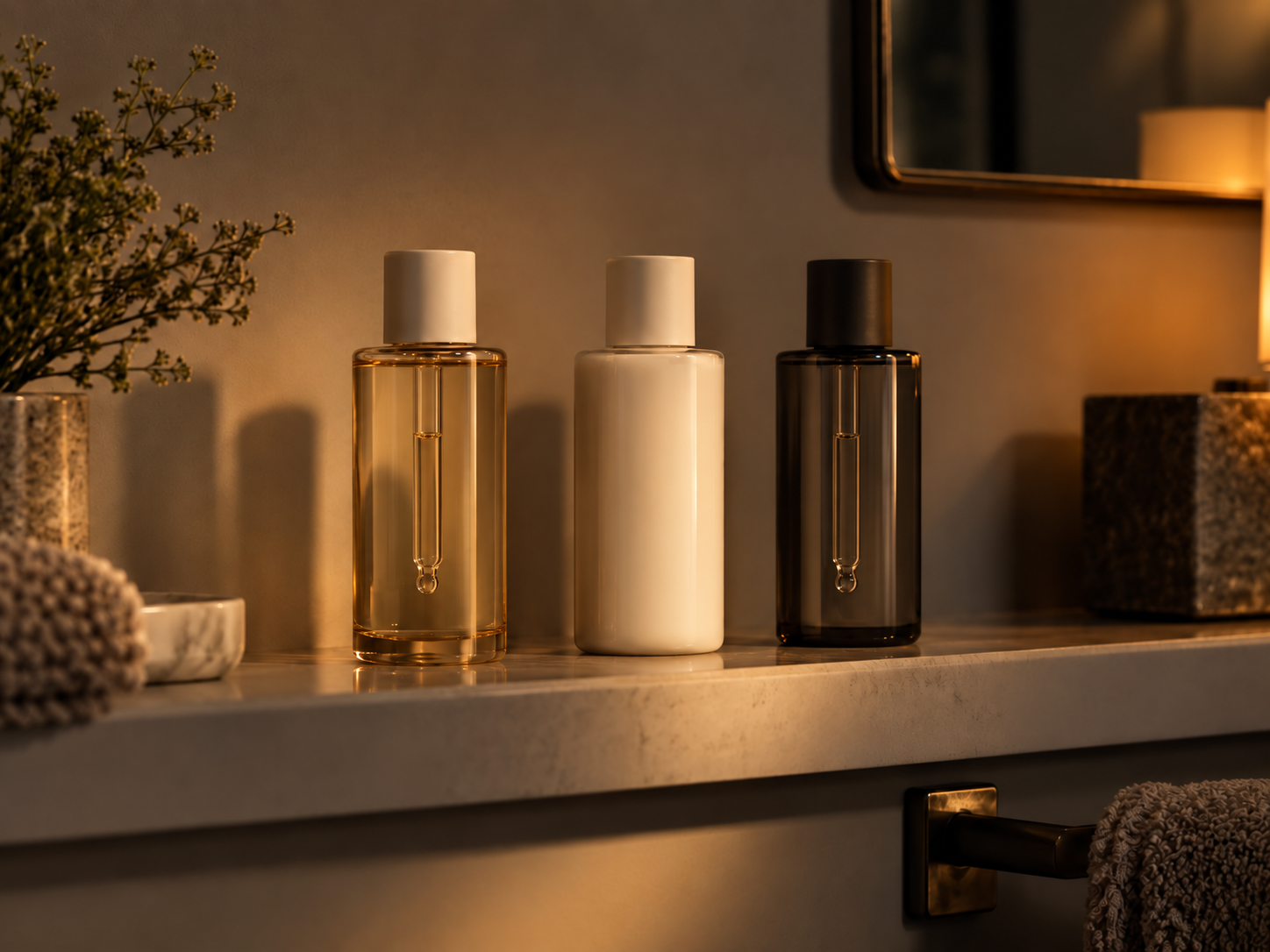
The research suggests framing matters. Rushed maintenance and deliberate ritual are not the same act.
Making a Skincare Ritual Worth the Minutes
If the framing genuinely matters, a few small adjustments follow from the research.
✦
Keep the sequence fixed
Predictability appears to be the active component rather than any particular step. Same order, same hand movements, roughly the same hour. Consistency of form matters more than the length of the routine.
✦
Name it as a ritual, deliberately
This sounds trivial and the research suggests otherwise. Belief that a sequence constitutes a ritual was identified as a critical ingredient. Deciding this is a ritual rather than a task appears to change what it delivers.
✦
Protect it from your phone
Attention is what separates ritual from routine. Scrolling through the steps removes the very quality the research points to. Leave the phone elsewhere for the few minutes involved.
✦
Let the products still be good ones
None of this replaces evidence-based formulation, and a pleasing ritual around a poor routine helps nobody. The Belldiva skin barrier repair guide covers what genuinely works on the skin itself.
Where this fits alongside everything else
Treat this as one modest good among several rather than a solution. Sleep, movement, and connection carry considerably more weight. Our piece on time outdoors covers another habit with a clearer evidence base.
The value here is proportionate and honest. A few predictable minutes belonging entirely to you, on a day that offered little else predictable, is worth something. It is not worth everything.
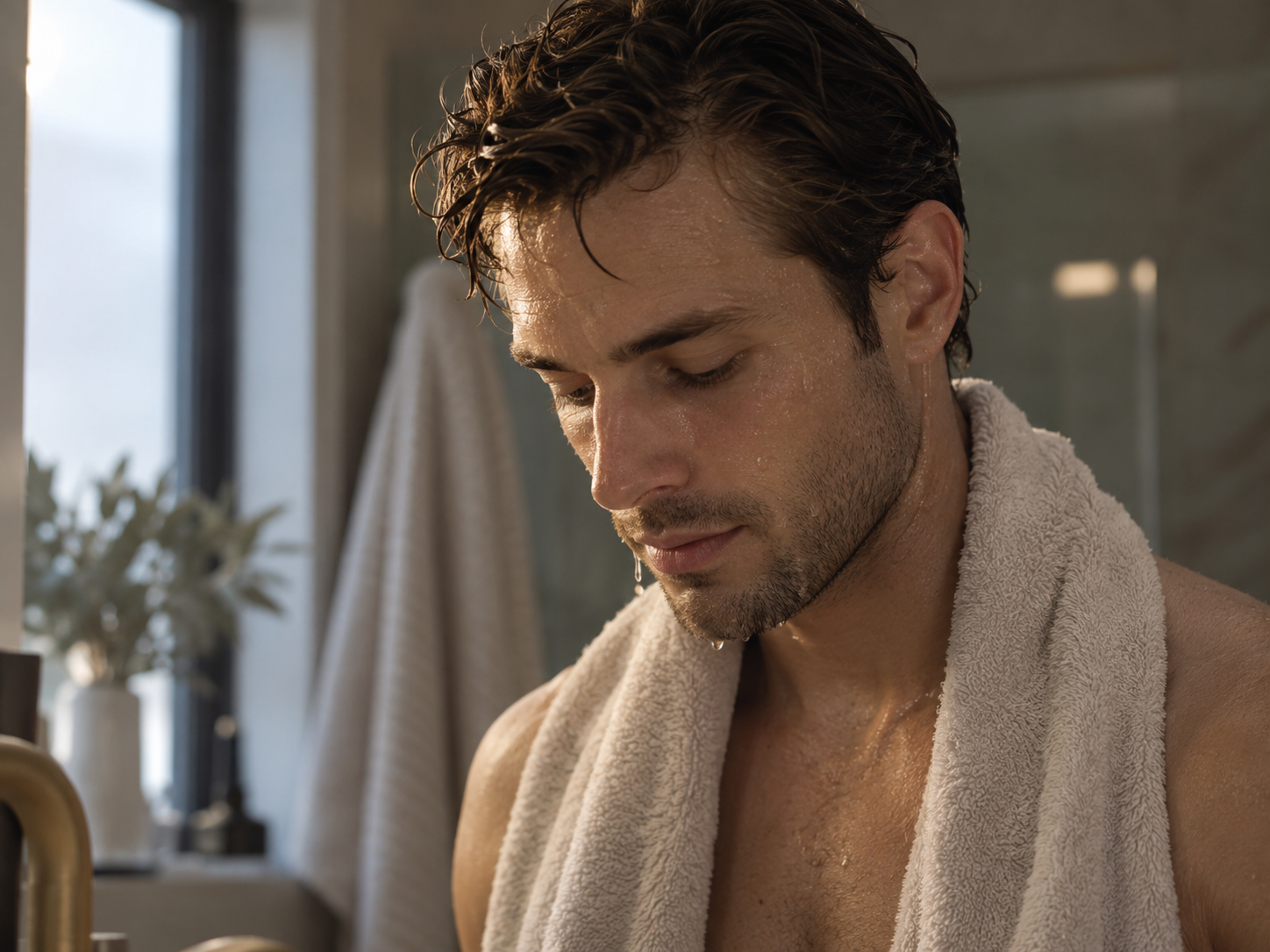
A few predictable minutes belonging entirely to you, on a day that offered little else predictable.
Wealth without wellness is incomplete, and some of what wellness asks for is simply attention paid to something small, on purpose.
Common Questions About the Skincare Ritual Idea
Direct answers to what comes up most, including where the honest response is to seek proper support.
Questions about the effect and its limits
Is this just a placebo effect?
The framing finding does suggest belief plays a part, which is genuinely interesting rather than dismissive. Researchers measured changes in heart rate variability alongside self-report, so something physiological occurs. Expectation shaping a real effect is not the same as no effect.
Does the routine need to be long or expensive?
Nothing in the research points to duration or cost. Predictability and attention are what the studies identified. A three-step routine performed the same way each evening fits the description entirely.
Questions about wellbeing and support
Can this help when I am genuinely struggling?
A small daily structure can be steadying, and it is not a substitute for proper support. If things feel heavy or persistent, please speak with your doctor or a qualified professional. That conversation matters far more than anything on a shelf.
Does this work the same for men?
Nothing in the ritual research suggests otherwise, since the mechanism concerns predictability rather than anything sex-specific. The studies included mixed participants across performance, grief, and everyday contexts.
Sources and research references
Brooks AW, Schroeder J, Risen JL, Gino F, Galinsky AD, Norton MI, Schweitzer ME. Don’t Stop Believing: Rituals Improve Performance by Decreasing Anxiety. Organizational Behavior and Human Decision Processes. 2016;137:71-85 (series of experiments, physiological and self-report anxiety measures)
Lang M, Krátký J, Xygalatas D. The role of ritual behaviour in anxiety reduction: an investigation of Marathi religious practices in Mauritius. Philosophical Transactions of the Royal Society B. 2020;375(1805):20190431 (n=75, heart rate variability and self-report)
Effects of predictable behavioral patterns on anxiety dynamics. Scientific Reports. 2022 (pre-registered, n=268, cognitive and physiological anxiety measures) | Norton MI, Gino F. Rituals Alleviate Grieving for Loved Ones, Lovers, and Lotteries. Journal of Experimental Psychology: General. 2014;143(1):266-272
The information in this guide is for educational purposes and reflects research current to mid-2026. It does not constitute medical advice, and a daily routine is not a substitute for professional care. If you are struggling with your wellbeing, please speak to your doctor or a qualified professional.
Rooted in Care. Refined in You.
Explore Belldiva’s Curated Collection
Over 70 luxury brands across skincare, wellness, and grooming. Every brand chosen for genuine excellence and real results.
Belldiva’s Curated Beauty and Wellness Brands
All Belldiva Brands
Huda Beauty
Charlotte Tilbury
Sephora
MAC
Dior
Katini Skin
Ultra Violette
NYX Cosmetics
The Ordinary
Verb Products
BK Beauty
Prada Beauty
Estée Lauder
Vasanti Cosmetics
Brickell
Lumin
Blu Atlas
Liomen
Jaxon Lane
Beardbrand
Scotch Porter
Bevel
Menfirst
Atlas
SkinCeuticals
Lululemon
Mindful
Headspace
Calm
Fitbit
MyFitnessPal
Noom
Peloton App
Organifi
Ritual
HUM Nutrition
Nike
YSL (Saint Laurent Beauty)
Lancôme
Clinique
NARS
Elizabeth Arden ✦
Victoria Beckham Beauty
Make Up For Ever
Valentino Beauty
Bobbi Brown
Shiseido
Benefit Cosmetics
Smashbox
Kylie Cosmetics
Urban Decay
Sigma Beauty
Stila ✦
Clarins
Tarte Cosmetics
PUR Cosmetics
Glossier
Elemis London
Kiehl’s
Murad
Paula’s Choice
Viori Beauty ✦
Life Extension
Lumen
Fiji Water
Anastasia Beverly Hills
Serious Skincare
Qure Skincare
Armani Beauty
Dr. Brandt ✦
skincare ritual
wellbeing
daily habits
behavioural science
self-care
skincare routine
stress
Belldiva wellness