
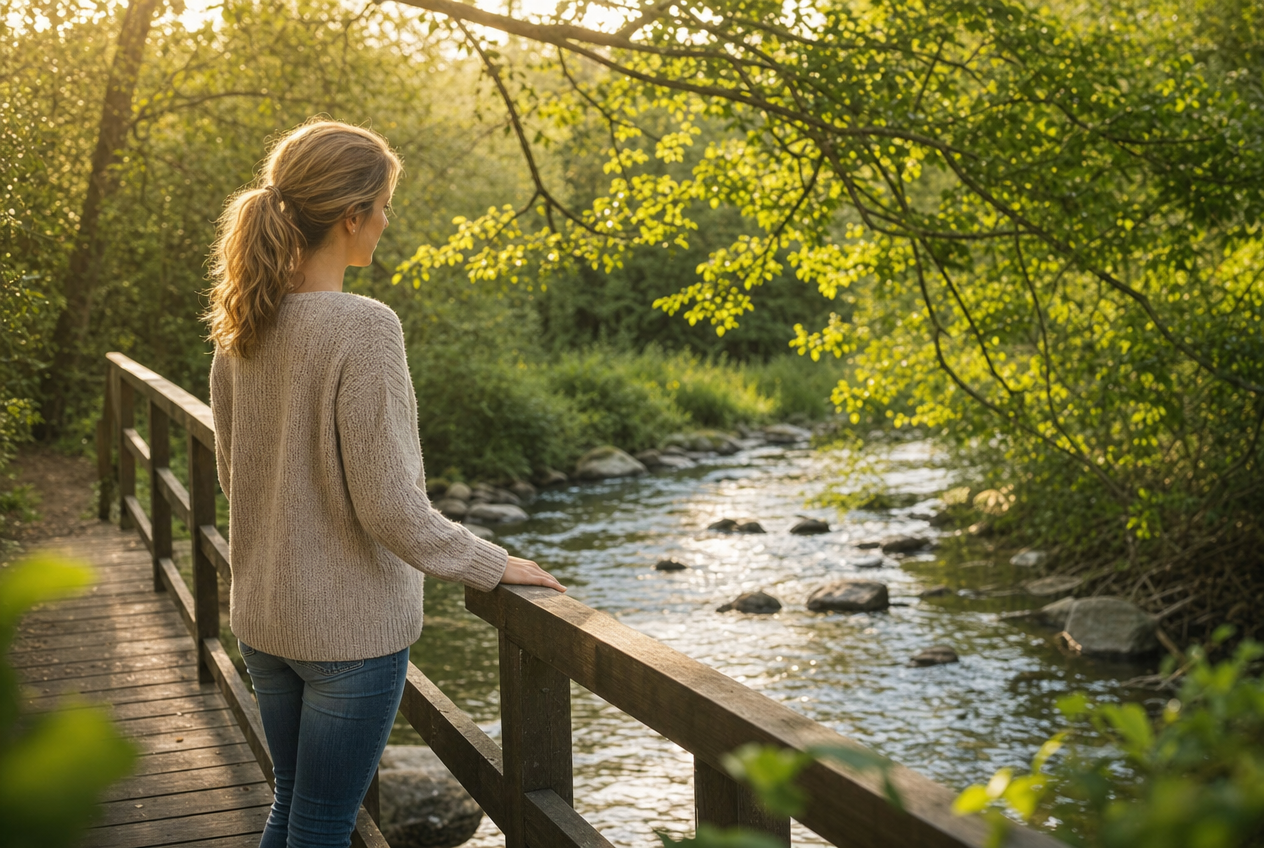
Getting Outside: What Time Outdoors Actually Does
Research on time outdoors points to a threshold that is lower and far more flexible than most people assume, for men and women alike.
Wellbeing
Daily Habits
Men & Women
By Belldiva Editorial • 2026 • 11–13 min read
Advice about getting outside usually arrives without a number attached. Spend time in nature, we are told, and you will feel better for it. The claim is pleasant, vague, and easy to ignore on a busy week.
There is, however, a genuinely useful figure behind it. Researchers examined time outdoors across a nationally representative sample of nearly twenty thousand people. What they found was a specific threshold, and it is considerably more achievable than most assume.
This guide covers what that study found, what the evidence can reasonably claim, and where honest limits sit. It also translates the finding into something workable. A number is only useful if you can build a week around it.
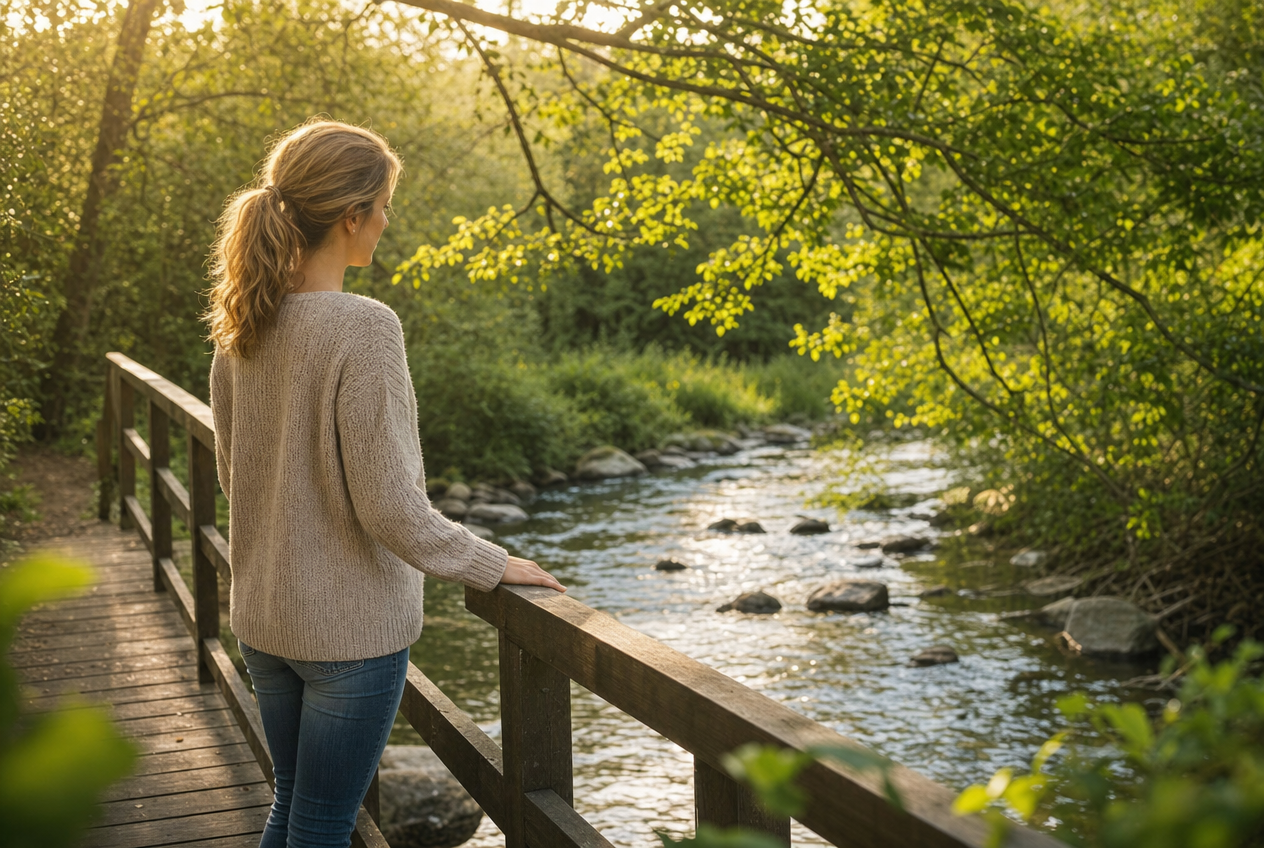
The research points to an ordinary walk rather than a wilderness expedition. That distinction matters.
What the Research on Time Outdoors Found
One study stands out for its scale, and its central finding is unusually practical.
The 120-minute threshold
White and colleagues published their analysis in Scientific Reports. They drew on 19,806 participants from a national survey, weighted to be nationally representative. That scale matters, because most wellbeing research rests on far smaller groups.
The pattern was clear. Compared with people reporting no nature contact, those reaching at least 120 minutes fared notably better. They were significantly more likely to report good health and high wellbeing. Below that threshold, the association did not reach significance.
Benefits also plateaued. Positive associations peaked somewhere between 200 and 300 minutes weekly, with no further gain beyond that. More time outdoors is pleasant, though the data suggests diminishing returns. In other words, this is not a habit you need to maximise.
How you split it does not matter
This is the most liberating part of the finding. The researchers reported that it made no difference how the 120 minutes were accumulated. One long weekend walk performed comparably to several short daily ones.
Consequently the barrier is lower than it appears. Roughly seventeen minutes a day reaches the threshold. A walk at lunch, a detour home, or twenty minutes in a park all count toward the same total. That flexibility is what makes the finding genuinely usable rather than aspirational.
Participants in the nationally representative survey analysed by White and colleagues in Scientific Reports
Minutes per week associated with reporting good health and high wellbeing
Minutes a day, roughly, if you prefer to spread that total across the week
Two hours a week, split however suits you. That is the whole threshold, and most people are closer to it than they think.
What This Evidence Can and Cannot Claim
A number this tidy deserves scrutiny, so here is where the honest limits sit.
Association is not the same as cause
The study was cross-sectional, meaning it captured a snapshot rather than tracking people over time. It therefore shows a strong association between time outdoors and self-reported wellbeing. It does not prove that one produces the other.
People who feel well may simply go outside more. The researchers controlled for a long list of factors, including physical activity, local green space, employment, and neighbourhood conditions. Nevertheless, that design limit remains, and any honest reading acknowledges it. The finding is worth acting on, but it is not proof.
What the biological measures add
Smaller studies have measured physiological markers directly. One published in Frontiers in Psychology tracked salivary cortisol before and after brief outdoor experiences. Levels fell measurably, with the steepest drop around twenty to thirty minutes.
That work involved a modest group rather than thousands, so it carries less weight on its own. Taken together with the large survey, though, it suggests something real is happening rather than merely being reported.
Well supported
A consistent association at 120 minutes weekly
Flexibility in how that time is split
Measurable short-term drops in stress markers
Not established
That going outside directly causes the benefit
That any setting works better than another
That it substitutes for professional support
Time outdoors is a supportive daily habit rather than a treatment. If you are struggling, speak to a qualified professional.
The setting in most of this research was ordinary green space, not remote wilderness.
Making Time Outdoors Fit a Real Week
The threshold is modest, so the practical question is simply where those minutes come from.
Attach it to something you already do
New habits survive when they lean on existing ones. Take a call while walking, park further away, or step out after lunch. Since the research found the split does not matter, these fragments genuinely count toward the same total.
Ordinary green space is enough
Participants in this research were not scaling mountains. A local park, a tree-lined street, a garden, or a riverside path all featured. Waiting for a proper outdoor trip is the most common reason people never start.
Protect your skin while you are out there
More daylight means more cumulative sun exposure, so this habit pairs with daily protection rather than replacing it. The Belldiva daily SPF guide covers why. Ultra Violette makes formulas built for wearing every day.
Let it double as movement
Walking outdoors satisfies two habits at once, which makes it far easier to sustain. The Belldiva stretching and conditioning guide pairs well with it. Lululemon and Nike both sit in the Belldiva movement collection.

Seventeen minutes a day reaches the threshold. A lunch break covers most of it.
Wealth without wellness is incomplete, and some of what wellness asks for costs nothing but the decision to step outside.
Common Questions About Time Outdoors
Direct answers to what comes up most, including where the honest response is that nobody has measured it.
Questions about how much and where
Does a city park count, or does it need to be real countryside?
Everyday green space featured throughout this research, including urban parks and tree-lined streets. The evidence does not establish that remote settings work better. Accessibility matters more, because the habit only helps if you actually keep it.
What if I cannot manage 120 minutes some weeks?
Treat it as a target rather than a rule. The threshold marks where the association became statistically significant, not a cliff edge below which nothing counts. Some time outdoors remains better than none.
Questions about weather and expectations
Does poor weather cancel the benefit?
The research did not isolate weather as a variable, so there is no clean answer. Practically, dressing for conditions removes most of the obstacle. Consistency across the year tends to matter more than any single pleasant afternoon.
Is this a substitute for proper support when things are hard?
No, and it should not be framed that way. Time outdoors is a supportive everyday habit alongside sleep, movement, and connection. If you are finding things difficult, speak to your doctor or a qualified professional.
Sources and research references
White MP, Alcock I, Grellier J, Wheeler BW, Hartig T, Warber SL, Bone A, Depledge MH, Fleming LE. Spending at least 120 minutes a week in nature is associated with good health and wellbeing. Scientific Reports. 2019;9:7730. doi:10.1038/s41598-019-44097-3 (n=19,806, nationally representative, cross-sectional)
Hunter MR, Gillespie BW, Chen SY. Urban nature experiences reduce stress in the context of daily life based on salivary biomarkers. Frontiers in Psychology. 2019;10:722. doi:10.3389/fpsyg.2019.00722 (smaller biomarker study, cited here as supporting rather than primary evidence)
The information in this guide is for educational purposes and reflects research current to mid-2026. It does not constitute medical advice, and time outdoors is not a substitute for professional care. If you are struggling with your wellbeing, please speak to your doctor or a qualified professional.
Rooted in Care. Refined in You.
Explore Belldiva’s Wellness Collection
Over 70 luxury brands across wellness, skincare, and movement. Every brand chosen for genuine excellence and real results.
Belldiva’s Curated Beauty and Wellness Brands
All Belldiva Brands
Huda Beauty
Charlotte Tilbury
Sephora
MAC
Dior
Katini Skin
Ultra Violette
NYX Cosmetics
The Ordinary
Verb Products
BK Beauty
Prada Beauty
Estée Lauder
Vasanti Cosmetics
Brickell
Lumin
Blu Atlas
Liomen
Jaxon Lane
Beardbrand
Scotch Porter
Bevel
Menfirst
Atlas
SkinCeuticals
Lululemon
Mindful
Headspace
Calm
Fitbit
MyFitnessPal
Noom
Peloton App
Organifi
Ritual
HUM Nutrition
Nike
YSL (Saint Laurent Beauty)
Lancôme
Clinique
NARS
Elizabeth Arden ✦
Victoria Beckham Beauty
Make Up For Ever
Valentino Beauty
Bobbi Brown
Shiseido
Benefit Cosmetics
Smashbox
Kylie Cosmetics
Urban Decay
Sigma Beauty
Stila ✦
Clarins
Tarte Cosmetics
PUR Cosmetics
Glossier
Elemis London
Kiehl’s
Murad
Paula’s Choice
Viori Beauty ✦
Life Extension
Lumen
Fiji Water
Anastasia Beverly Hills
Serious Skincare
Qure Skincare
Armani Beauty
Dr. Brandt ✦
time outdoors
wellbeing
nature and health
walking
daily habits
green space
stress
Belldiva wellness