Stretching and Conditioning: The Half of Strength Training Most People Skip
Weight training builds the muscle. Stretching and conditioning are what let you keep using it without breaking down.
Mobility
Weight Training
Strength Training
Recovery
By Belldiva Editorial • June 2026 • 11–13 min read
Stretching and conditioning rarely get the same respect as weight training. For many men, that gap shows up later as tightness, nagging pain, or a sidelined program. Weight training builds the muscle and the strength. Stretching and conditioning are what let the body use that strength safely. Lifting weights alone does not reliably protect joints or movement quality, and skipping mobility work is consistently linked to a higher rate of training injuries. This guide explains why stretching and conditioning deserve equal billing with weight training, why men in particular tend to skip it, and what an effective, realistic approach actually looks like. All sources are peer-reviewed and published between 2023 and 2026.

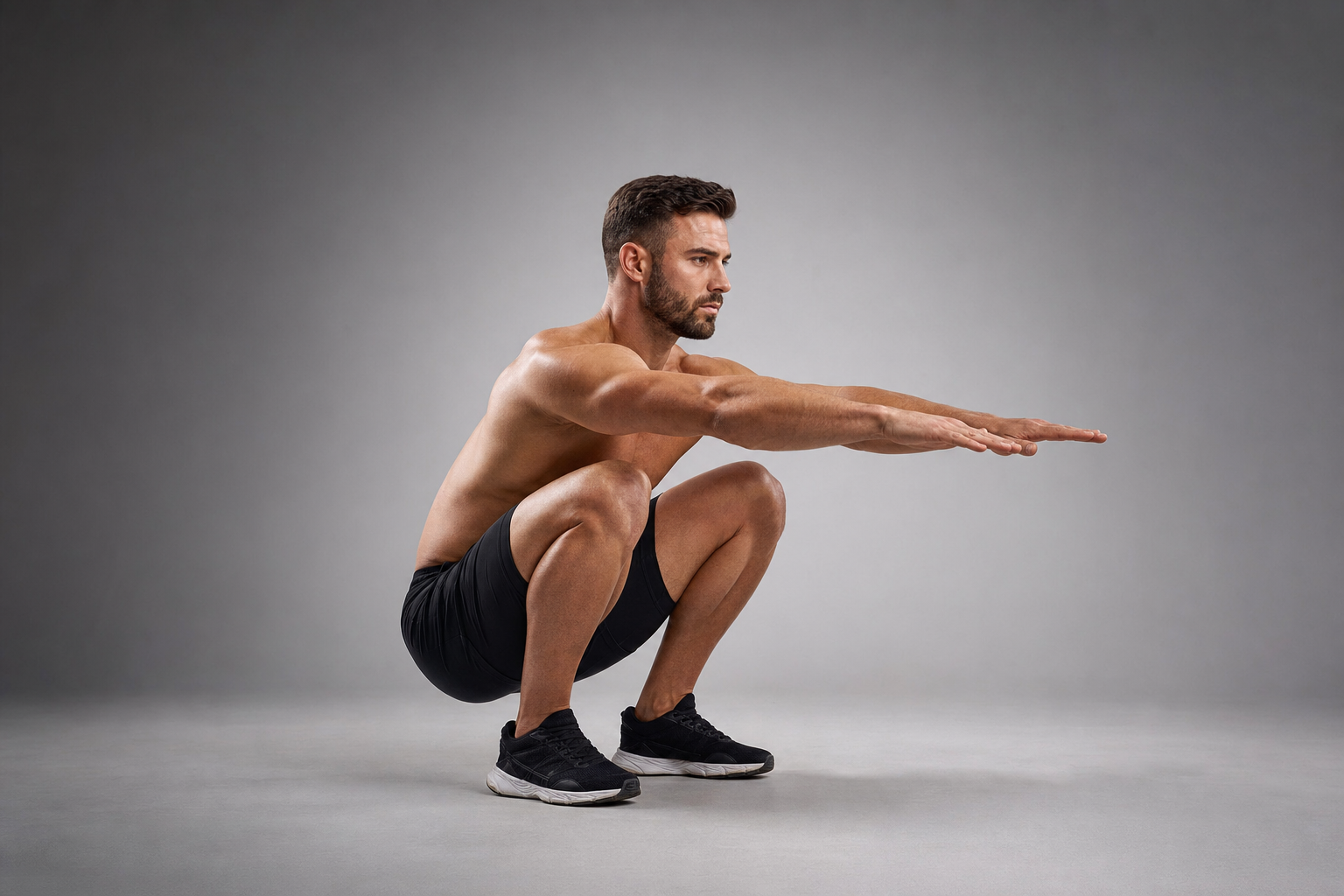
A few minutes of dynamic movement before training prepares the joints for the exact ranges about to be loaded.
Why stretching and conditioning matter alongside weight training
Lifting heavier is not the same as moving well. Here is what the research actually shows about the two working together.
Weight training alone does not guarantee flexibility
A 2025 systematic review and meta-analysis in the Journal of Strength and Conditioning Research looked closely at this exact question. It found that resistance training can improve flexibility to some degree. However, the effect was inconsistent across studies and far smaller than the gains seen from dedicated stretching work. In plain terms, lifting weights is not a substitute for stretching, even though both train the same muscles. The two address different parts of how a joint and muscle actually function.
Flexibility and mobility are not quite the same thing
Flexibility is the passive range a joint can reach. Mobility is how much of that range you can actually use while moving and under load. You can be flexible and still lack mobility, especially if you cannot access that range without help. Conditioning ties the two together by training the body to move well while fatigued, not just while fresh. A 2024 review on injury patterns across weight-training sports identified insufficient flexibility and mobility training as one of the clearest contributors to musculoskeletal injury. That single finding is the core argument for treating stretching and conditioning as essential, not optional.
Daily eccentric strength work shown to improve flexibility, fitness, and strength in previously sedentary adults (2025 study)
Training block length used in recent clinical trials measuring real flexibility change from stretching
Distinct qualities, flexibility and mobility, that research shows must be trained together for real protection
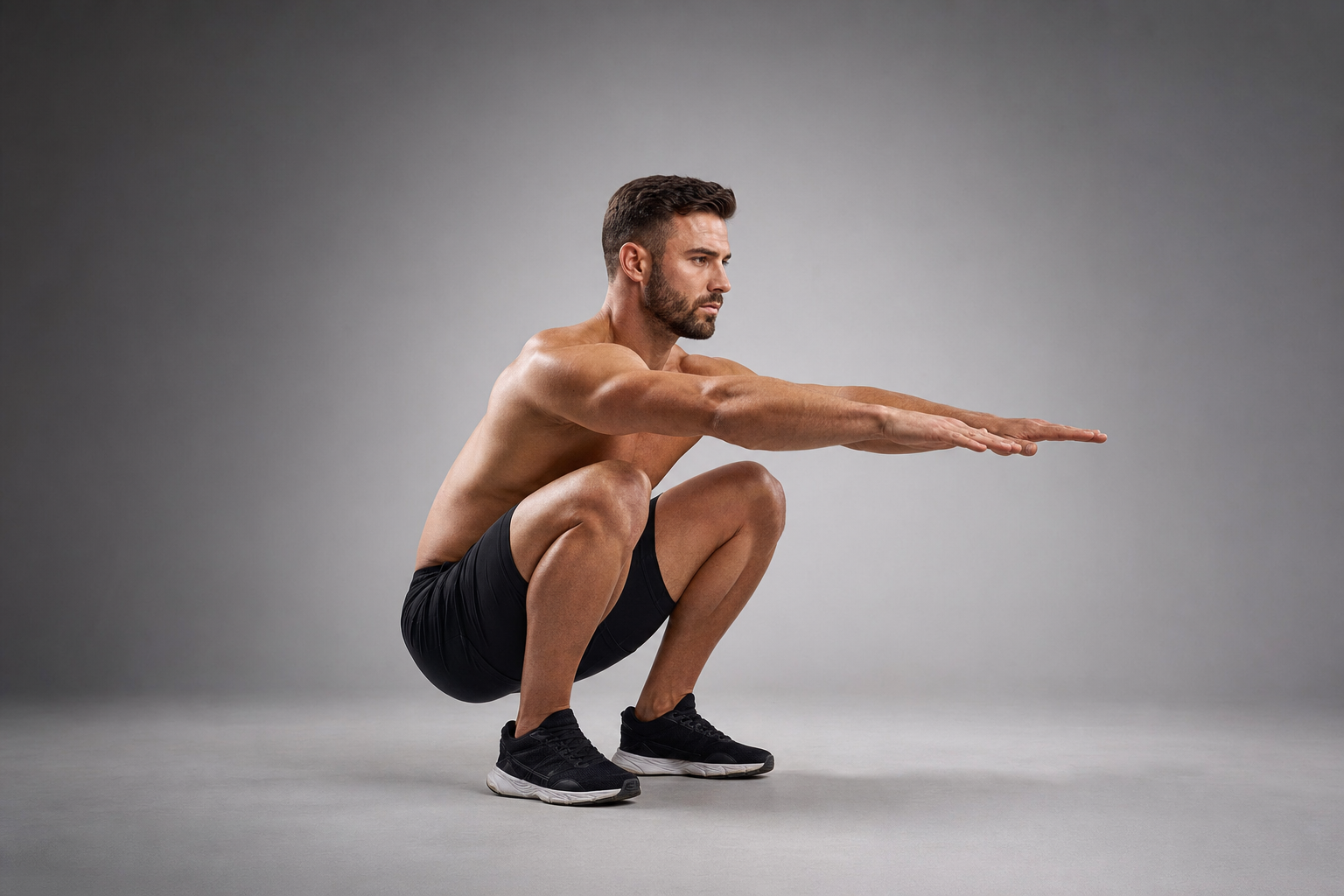
Squat depth is one of the fastest ways to see a restricted joint reveal itself.
Why men in particular tend to skip this
The four gaps below apply to anyone who lifts. Men are statistically more likely to skip the work that closes them, which is worth understanding on its own.
Men tend to start from a flexibility disadvantage
On average, men report lower flexibility scores than women across most standard mobility tests. Genetics and hormones both play a role in this. It means the same amount of skipped stretching tends to cost men more range of motion over time than it would cost a more naturally flexible training partner. Add heavier loads on top of that gap, and the case for deliberate mobility work becomes much stronger.
Heavier loads raise the stakes
Men also tend to gravitate toward heavier loads and gym cultures that treat stretching as optional accessory work rather than real training. That perception is outdated. The heavier the load, the less room there is for a tight hip or a stiff shoulder to quietly shift stress onto a joint that was never built to absorb it. Conditioning work compounds this further, since it trains the body to keep good form once fatigue sets in, exactly when most injuries actually happen.
Four common gaps that show up first
01
Tight hips, strained lower back
Long hours seated combined with skipped hip flexor stretches limit the starting position on squats and deadlifts. The lumbar spine often takes on the extra movement, raising the risk of lower back pain.
02
Stiff shoulders, compensating lower back
Restricted overhead shoulder mobility forces other joints to compensate during pressing movements. The lower back frequently absorbs that extra range, which is rarely where the strain was supposed to go.
03
Restricted ankles, strained knees
Poor ankle mobility limits how deep and how safely you can squat. Once depth is restricted, the knees often shift forward to compensate, taking on load they were not designed to manage alone.
04
Stiff upper back, rounded posture
Desk postures combined with heavy pressing and little pulling work can compound rounded shoulders over time. Mobility and conditioning for the upper back are what keep posture from quietly drifting in one direction.
How to know which mobility gap applies to you
A few simple checks, no equipment required, reveal where your own routine might be falling short.
The hip flexor test
Kneel on one knee with the back foot flat behind you. Gently push your hips forward without letting your lower back arch. If you feel a strong pull in the front of the back hip well before your hips are square, your hip flexors are likely tight.
The ankle wall test
Stand facing a wall with your toes about four inches away. Try to touch your knee to the wall without lifting your heel. If your heel lifts, or your knee cannot reach the wall, ankle mobility is probably limiting your squat depth.
The overhead reach test
Lie flat on your back with your knees bent and your lower back pressed into the floor. Raise both arms overhead and try to touch the floor behind you without your back arching off the ground. If your arms stop well short, shoulder mobility needs attention.
The seated rotation test
Sit tall with your arms crossed over your chest. Rotate your upper body as far as you comfortably can to each side without letting your hips move. A noticeable difference between sides, or limited rotation overall, points to a stiff upper back.
A joint that cannot reach a position will recruit a different joint to get there. That borrowed range almost always costs something later.
Building a stretching and conditioning routine that actually sticks
This does not need to add an hour to your day. It needs to be placed correctly around the lifting you already do.
Dynamic movement before training
Static stretching before lifting can temporarily reduce strength and power output, which is why it is no longer widely recommended as a warm-up. Dynamic movement raises blood flow and prepares the joints for the specific ranges you are about to load. On a lower body day, try walking lunges with a twist, leg swings in both directions, and bodyweight squats with a brief pause at the bottom. On an upper body day, band pull-aparts, arm circles, and light shoulder dislocates cover the same ground. Five to eight minutes before the first working set is usually enough.
Static stretching and mobility work after training
Save the longer, held stretches for after the workout, when muscles are warm and strength output is no longer the priority. A 2024 systematic review found that consistent static stretching over several weeks can meaningfully increase range of motion, and in some studies, even contributes to strength and muscle growth. A useful after-training block covers a couch stretch for the hip flexors, a doorway stretch for the chest and shoulders, a child’s pose hold for the upper back, and a wall calf stretch for the ankles. Ten to fifteen minutes spent on the areas trained that day is a realistic target.
Conditioning as its own dedicated session
Conditioning belongs in the weekly schedule as its own session, not as an afterthought tacked onto leg day. Two short sessions a week build the kind of fatigue resistance that keeps form intact late in a heavy set. A simple starting protocol is six rounds of thirty seconds of hard effort followed by ninety seconds of rest, using something like a sled push, kettlebell swings, or a stationary bike. This is exactly where most injuries tend to occur, so the carryover into the weight room is direct.

Good conditioning work is built on simple, repeatable timing, not guesswork.
Three conditioning formats worth building into your week
Conditioning is not one single method. These three formats each train a slightly different capacity.
Interval training
Short bursts of hard effort followed by deliberate rest build the ability to recover quickly between sets. That is exactly what late reps in a heavy lift demand. A simple structure is twenty to thirty seconds of hard effort on a bike, rower, or sled, followed by sixty to ninety seconds of easy movement, repeated six to eight times.
Loaded carries
Walking for distance or time while holding a heavy weight builds grip, core stability, and shoulder endurance all at once. Farmer’s carries, suitcase carries, and overhead carries each challenge a slightly different pattern. All three translate directly into a more stable bracing position under a loaded bar.
Circuit-style strength-endurance work
Moving through a small set of exercises back to back with minimal rest trains the body to maintain technique while fatigued, which is the entire point of conditioning. A simple circuit pairs a push, a pull, and a carry for three to four rounds, resting only between full rounds rather than between individual exercises.
A sample week: a practical way to fit stretching and conditioning around a typical lifting schedule without adding much extra time.
Monday, lower body lifting. Dynamic hip and ankle work beforehand, static stretching for the hips and calves after.
Tuesday, conditioning. Twenty minutes of intervals or loaded carries.
Wednesday, upper body lifting. Dynamic shoulder work beforehand, static stretching for the chest and upper back after.
Thursday, rest or an easy walk.
Friday, full body or a second lower body day. Same warm-up and cooldown structure as Monday.
Saturday, conditioning. A different format from Tuesday for variety.
Sunday, rest.
Recovery, skin, and the bigger wellness picture
Training harder without recovering properly raises cortisol in much the same way chronic stress does. As covered in our stress and skin guide, sustained high cortisol weakens the skin barrier and slows healing. Adding conditioning volume without adequate sleep and recovery can quietly work against the very results you are training for, on the skin as much as in the muscle.
More frequent training also means more sweat, more friction, and more time spent in workout clothing against the skin. A simple post-workout routine, a gentle cleanser and a barrier-friendly moisturiser, prevents the body breakouts and chafing that often follow an increase in training volume. Our active body care guide covers this in more detail. Brands such as Brickell, Lumin, and Atlas all carry simple post-workout skincare suited to a more active routine.
Strength that cannot be used safely is not really strength. It is a number on a bar.

Recovery is not the least important part of training. For most people, it is the most skipped.
Your stretching and conditioning questions answered
Common questions about stretching and conditioning
Will stretching make me less strong?
Not when it is timed correctly. Static stretching right before a heavy lift can temporarily reduce power, which is why it belongs after training rather than before. Used this way, stretching has been linked to real strength and flexibility gains over time, not a loss.
How much time should stretching and conditioning actually take?
A realistic target is five to eight minutes of dynamic movement before lifting, ten to fifteen minutes of static stretching after, and two short conditioning sessions per week. That is a fraction of total training time for a meaningful return.
More stretching and conditioning questions
Can I just stretch the tight areas and skip the rest?
Targeted work helps, but the body tends to compensate as a system. A tight hip can show up as knee pain, and a stiff shoulder can show up as a sore lower back. A broader routine covering hips, shoulders, ankles, and the upper back addresses the pattern, not just the symptom.
Is conditioning the same as cardio?
Not quite. Cardio typically targets heart and lung fitness over a steady, longer effort. Conditioning is broader and includes the ability to maintain strength, technique, and control once fatigue sets in, which is exactly the quality that protects against injury during a heavy lifting session.
A few more practical questions
Do I need different stretches for different lifts?
Not dramatically. The same four areas, hips, shoulders, ankles, and the upper back, cover almost every major lift. What changes is which area gets a little more attention based on what you trained that day, not the actual list of stretches.
What if I only have time for one of the three?
Static stretching after training is the easiest single addition with the clearest research support for range of motion. If time is genuinely limited, start there, then add conditioning sessions once the habit is established.
Stretching and conditioning: the other half of a strong program
Weight training will always get the attention. It is visible, it is measurable, and the progress feels immediate. Stretching and conditioning work more quietly, but they are what keep that progress intact for the long run rather than interrupted by an avoidable injury, whether you are the one most likely to skip them or not.
At Belldiva, we believe wealth without wellness is incomplete. A training program built on strength alone is only half the picture. The other half is the mobility, conditioning, and recovery that let you keep showing up to use that strength.
Wealth without wellness is incomplete. Rooted in Care. Refined in You.
Sources and research references
Favro F et al. The influence of resistance training on joint flexibility in healthy adults: a systematic review, meta-analysis, and meta-regression. Journal of Strength and Conditioning Research. PMC11841725 | Prevalence and pattern of injuries across the weight-training sports. PMC. 2024 | Warneke K, Lohmann LH, Behm DG et al. Effects of chronic static stretching on maximal strength and muscle hypertrophy: a systematic review and meta-analysis. Sports Medicine Open. 2024 | Practical recommendations on stretching exercise: a Delphi consensus statement of international research experts. 2025 | Effectiveness of active stretching during training for injury prevention and performance enhancement in sports: a systematic review and meta-analysis. Turkish Journal of Sports Medicine. 2026 | Comparison between six weeks of static stretching and resistance training programs on passive and active properties of plantar flexors: a randomized controlled trial. Frontiers in Physiology. 2025
The information in this guide is for educational purposes and reflects research current to June 2026. It does not constitute medical or fitness advice. Please consult a qualified trainer, physiotherapist, or physician before beginning a new training program, particularly if you are managing an existing injury.
Rooted in Care. Refined in You.
Explore Belldiva’s Curated Skincare Collection
Over 70 luxury brands in beauty, skincare, hair, and wellness. Every brand chosen for genuine excellence and real results.
Belldiva’s Curated Beauty and Wellness Brands
All Belldiva Brands
Huda Beauty
Charlotte Tilbury
Sephora
MAC
Dior
Katini Skin
Ultra Violette
NYX Cosmetics
The Ordinary
Verb Products
BK Beauty
Prada Beauty
Estée Lauder
Vasanti Cosmetics
Brickell
Lumin
Blu Atlas
Liomen
Jaxon Lane
Beardbrand
Scotch Porter
Bevel
Menfirst
Atlas
SkinCeuticals
Lululemon
Mindful
Headspace
Calm
Fitbit
MyFitnessPal
Noom
Peloton App
Organifi
Ritual
HUM Nutrition
Nike
YSL (Saint Laurent Beauty)
Lancôme
Clinique
NARS
Elizabeth Arden ✦
Victoria Beckham Beauty
Make Up For Ever
Valentino Beauty
Bobbi Brown
Shiseido
Benefit Cosmetics
Smashbox
Kylie Cosmetics
Urban Decay
Sigma Beauty
Stila ✦
Clarins
Tarte Cosmetics
PUR Cosmetics
Glossier
Elemis London
Kiehl’s
Murad
Paula’s Choice
Viori Beauty ✦
Life Extension
Lumen
Fiji Water
Anastasia Beverly Hills
Serious Skincare
Qure Skincare
Armani Beauty
Dr. Brandt ✦
RoC ✦
stretching and conditioning
weight training
mobility training
flexibility training
men’s fitness
injury prevention
recovery
conditioning
post workout skin care
Belldiva wellness